

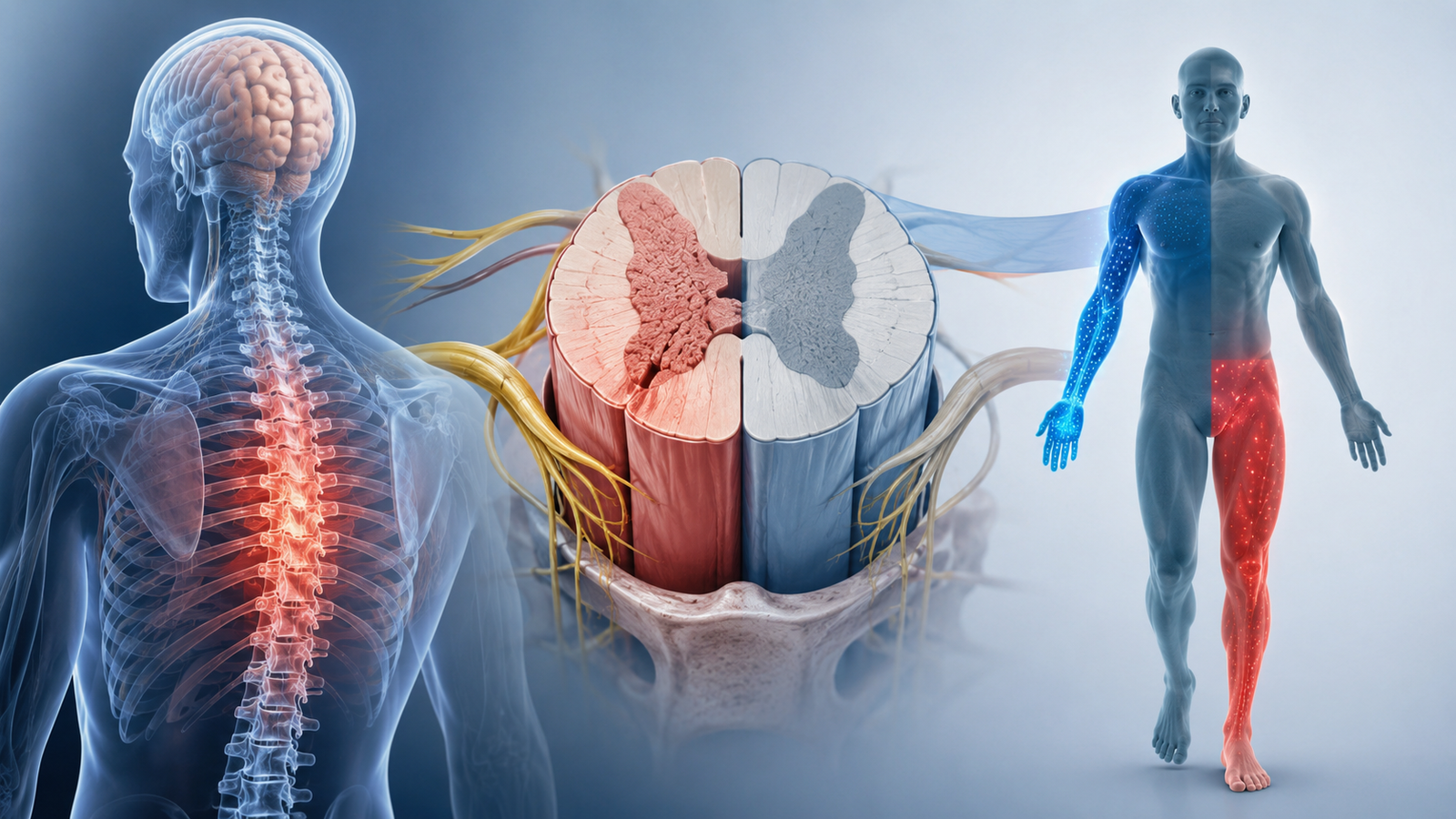
Brown-Séquard syndrome is an uncommon incomplete spinal cord injury that can affect strength, sensation, balance and walking. Learn about its causes, symptoms, diagnosis, recovery and evidence-informed physiotherapy rehabilitation.
Brown-Séquard syndrome (BSS) is an uncommon neurological condition caused by damage affecting one side of the spinal cord. Because the spinal cord carries different types of movement, sensation and pain/temperature signals through different pathways, an injury to one side can produce a distinctive combination of neurological problems.
For patients and families, the condition can initially be confusing. Weakness may be more noticeable on one side, while loss of pain or temperature sensation may occur differently. Understanding these patterns can help patients recognize why rehabilitation is often an important part of recovery.
Physiotherapy does not repair a damaged spinal cord directly, but appropriately planned rehabilitation can help a person improve movement, balance, walking ability, functional independence and participation in everyday activities.
Important: Brown-Séquard syndrome requires medical and neurological assessment. New or rapidly worsening weakness, numbness, difficulty walking, bladder/bowel changes or other spinal cord symptoms should be assessed urgently.
What Is Brown-Séquard Syndrome?
Brown-Séquard syndrome is a partial spinal cord injury syndrome in which one side of the spinal cord is predominantly affected.
The spinal cord contains several pathways responsible for:
- Voluntary movement
- Position and vibration sensation
- Pain and temperature sensation
- Coordination of information between the brain and body
When one side of the spinal cord is damaged, these pathways can be affected in different ways. This produces a characteristic neurological pattern.
Brown-Séquard syndrome is sometimes described as spinal cord hemisection syndrome, although a complete anatomical hemisection is not present in every patient.
Why does one spinal cord injury cause different symptoms?
The key is that different nerve pathways travel through the spinal cord differently.
For example:
- Some motor pathways have already crossed before reaching the spinal cord.
- The pathway carrying vibration and position information crosses higher up, in the brainstem.
- Pain and temperature pathways generally cross within the spinal cord, often within a few spinal segments of entering it.
Therefore, damage to one side of the spinal cord can affect movement and certain sensations on the same side while affecting pain and temperature sensation on the opposite side.
Brown-Séquard Syndrome Symptoms
Symptoms depend on the level, severity and cause of spinal cord involvement.
A classic pattern may include:
1. Weakness on the affected side
Damage to descending motor pathways can cause weakness or paralysis on the same side of the body below the level of the spinal cord lesion.
Patients may experience:
- Difficulty standing
- Reduced leg strength
- Difficulty walking
- Poor foot control
- Reduced hand function when the cervical spinal cord is involved
- Reduced ability to perform daily activities
The severity varies considerably from one patient to another.
2. Loss of vibration and position sense
The affected side may have impaired:
- Joint-position sense
- Vibration sensation
- Fine touch discrimination
This can make walking and balance more difficult because the brain receives less accurate information about where the limbs are positioned.
3. Loss of pain and temperature sensation
Pain and temperature sensation may be reduced on the opposite side of the body, usually beginning several spinal segments below the lesion.
This is one of the features that can make Brown-Séquard syndrome clinically distinctive.
4. Changes in reflexes
Reflex findings can vary depending on:
- The level of the spinal cord injury
- Whether the lesion is acute or chronic
- Which neurological pathways are involved
An acute spinal cord lesion may initially produce different findings from those seen later during recovery.
5. Changes in muscle tone
Some patients may develop increased muscle tone or spasticity below the level of the lesion.
Spasticity may contribute to:
- Stiff movements
- Difficulty bending or straightening joints
- Abnormal walking patterns
- Muscle spasms
- Reduced functional movement
However, not every person with Brown-Séquard syndrome develops significant spasticity.
Causes of Brown-Séquard Syndrome
Brown-Séquard syndrome can occur due to different conditions that damage one side of the spinal cord.
Common causes include:
- Traumatic spinal cord injury
- Penetrating spinal injuries
- Spinal fractures or dislocations
- Spinal tumors
- Cervical or thoracic spinal cord compression
- Inflammatory conditions
- Multiple sclerosis
- Infections
- Vascular problems affecting the spinal cord
- Less commonly, other structural or neurological disorders
The cause is important because treatment and prognosis depend not only on the neurological pattern but also on the underlying condition.
Brown-Séquard Syndrome and Spinal Cord Level
The location of the spinal cord lesion strongly influences symptoms.
Cervical spinal cord involvement
A lesion in the neck region can affect:
- Arms
- Hands
- Trunk
- Legs
- Walking
- Balance
Higher cervical involvement can potentially affect more extensive motor and sensory functions.
Thoracic spinal cord involvement
Thoracic lesions may primarily affect:
- Trunk control
- Lower-limb strength
- Lower-limb sensation
- Standing and walking
Lumbar or lower spinal cord involvement
The clinical presentation can differ substantially because the anatomy of the spinal cord changes toward its lower end.
For this reason, a neurological examination is essential rather than assuming that every Brown-Séquard syndrome patient will have the same symptoms.
How Is Brown-Séquard Syndrome Diagnosed?
Diagnosis involves combining the patient’s history with a detailed neurological examination and appropriate investigations.
A doctor may assess:
- Muscle strength
- Muscle tone
- Deep tendon reflexes
- Superficial sensation
- Pain and temperature sensation
- Vibration
- Proprioception
- Coordination
- Balance
- Walking ability
- Bladder and bowel function
- Level of the spinal cord affected
Imaging
MRI of the spine is particularly important for evaluating the spinal cord and identifying conditions such as:
- Spinal cord compression
- Edema
- Hemorrhage
- Tumors
- Inflammatory lesions
- Other structural abnormalities
CT or other investigations may also be appropriate depending on the suspected cause, particularly after trauma.
Brown-Séquard Syndrome vs Complete Spinal Cord Injury
Brown-Séquard syndrome is generally considered an incomplete spinal cord injury.
This means that some neurological pathways remain intact.
In an incomplete spinal cord injury, a person may retain varying degrees of:
- Motor function
- Sensation
- Voluntary movement
- Trunk control
- Walking potential
The amount of preserved function differs significantly between individuals.
This is why rehabilitation should be based on the person’s actual neurological and functional presentation rather than the diagnosis alone.
Physiotherapy Management of Brown-Séquard Syndrome
Physiotherapy is an important component of multidisciplinary rehabilitation for many people with Brown-Séquard syndrome.
The treatment plan should be individualized after neurological and musculoskeletal assessment.
The primary goals may include:
- Maintaining joint mobility
- Preventing secondary complications
- Improving muscle strength
- Improving postural control
- Developing balance
- Improving walking
- Increasing functional independence
- Improving cardiovascular fitness
- Training safe transfers
- Improving participation in daily activities
1. Initial Physiotherapy Assessment
A physiotherapist may assess:
Motor function
- Manual muscle testing
- Functional movement
- Selective motor control
- Lower- and upper-limb strength
Sensory function
- Light touch
- Pain and temperature awareness
- Proprioception
- Vibration where appropriate
Tone and reflexes
Assessment for:
- Spasticity
- Hypotonia
- Abnormal reflex activity
- Clonus
Functional mobility
The physiotherapist may evaluate:
- Rolling
- Sitting
- Sit-to-stand
- Transfers
- Standing
- Walking
- Stair negotiation
- Bed mobility
Balance
Both static and dynamic balance should be assessed.
This is especially important when proprioception or lower-limb sensory information is impaired.
Exercise Therapy for Brown-Séquard Syndrome
Exercise selection should depend on the person’s neurological status, medical stability and functional goals.
1. Active and active-assisted exercises
These can help maintain movement and encourage motor control.
Examples may include:
- Hip flexion and extension
- Knee flexion and extension
- Ankle movements
- Shoulder movements
- Elbow flexion and extension
- Wrist and hand exercises
The exercises should be performed within safe ranges and adjusted according to strength and control.
2. Strengthening exercises
Progressive strengthening can be considered when adequate movement is available.
Examples include:
- Sit-to-stand practice
- Supported squats
- Resistance-band exercises
- Step-ups
- Bridging
- Hip strengthening
- Knee strengthening
- Ankle strengthening
Resistance and repetitions should be progressed gradually.
3. Balance training
Balance rehabilitation may include:
- Sitting balance
- Weight shifting
- Supported standing
- Reaching activities
- Standing with reduced upper-limb support
- Controlled stepping
- Dynamic balance activities
If proprioception is impaired, visual information may become particularly important during certain tasks.
4. Gait training
Walking rehabilitation may involve:
- Parallel-bar walking
- Weight-shifting practice
- Step training
- Assistive-device training
- Treadmill-based gait training when appropriate
- Overground walking
- Stair training
An appropriate walking aid may improve safety and independence.
The device should be selected after individual assessment rather than simply choosing one based on diagnosis.
Neurorehabilitation Techniques
Depending on the patient’s presentation, physiotherapy may incorporate principles from neurological rehabilitation such as:
- Task-specific training
- Repetitive movement practice
- Motor relearning
- Balance and postural training
- Functional strengthening
- Gait re-education
- Proprioceptive training
- Coordination exercises
- Facilitation techniques where clinically appropriate
The emphasis should be on meaningful, goal-directed practice rather than performing exercises without a functional purpose.
Management of Spasticity and Muscle Tightness
Some people with Brown-Séquard syndrome develop increased muscle tone.
Physiotherapy may include:
- Slow controlled movements
- Active range-of-motion exercises
- Positioning
- Functional weight-bearing
- Stretching when appropriate
- Strength and motor-control training
- Gait training
- Education about triggers that worsen symptoms
Persistent or severe spasticity may require medical management in addition to physiotherapy.
A sudden increase in spasticity should not automatically be treated by simply stretching harder. Possible triggers such as pain, infection, skin problems, bladder issues or other medical complications may need evaluation.
Physiotherapy for Walking Difficulties
Walking problems can result from a combination of:
- Muscle weakness
- Reduced proprioception
- Poor balance
- Altered muscle tone
- Reduced motor control
- Sensory loss
- Joint stiffness
- Reduced endurance
Therefore, gait rehabilitation should address the cause of the walking limitation, not just the walking pattern.
A physiotherapist may work on:
- Trunk control
- Standing alignment
- Weight transfer
- Foot placement
- Step length
- Knee control
- Hip control
- Ankle control
- Balance
- Walking endurance
Occupational and Functional Rehabilitation
Physiotherapy is only one part of rehabilitation.
Depending on the patient’s needs, a multidisciplinary team may include:
- Neurologist
- Neurosurgeon or spine specialist
- Physiotherapist
- Occupational therapist
- Rehabilitation physician
- Speech and language therapist when indicated
- Psychologist or counsellor when appropriate
- Nursing professionals
Occupational therapy can be particularly helpful for improving independence in activities such as dressing, bathing, feeding and household tasks.
Home Physiotherapy Advice for Brown-Séquard Syndrome
A structured home program can complement supervised rehabilitation.
Useful principles include:
- Perform prescribed exercises regularly.
- Practice safe transfers rather than attempting difficult movements without assistance.
- Use prescribed walking aids correctly.
- Keep frequently used household objects within safe reach.
- Remove loose rugs and other fall hazards.
- Wear appropriate footwear.
- Avoid walking alone if balance is significantly impaired.
- Inspect areas with reduced sensation regularly for injuries or pressure-related skin problems.
- Follow the medical team’s recommendations regarding spinal precautions.
Do not push through significant neurological symptoms
Exercise should not cause new or progressively worsening:
- Weakness
- Numbness
- Severe pain
- Dizziness
- Loss of balance
- Bladder or bowel changes
Such symptoms warrant medical assessment.
Precautions During Physiotherapy
Brown-Séquard syndrome requires careful rehabilitation planning.
Important precautions include:
- Follow spinal precautions when prescribed.
- Avoid aggressive spinal manipulation unless specifically medically indicated and appropriately cleared.
- Monitor fatigue during exercise.
- Protect areas with reduced sensation from heat and pressure injuries.
- Use appropriate support during standing and gait training.
- Progress exercise gradually.
- Monitor skin condition in patients with reduced mobility.
- Consider fall risk before balance or walking exercises.
- Coordinate rehabilitation with the treating medical team when significant neurological changes occur.
Heat-based modalities require particular caution when pain or temperature sensation is impaired because the patient may not adequately detect excessive heat.
Can Brown-Séquard Syndrome Improve?
Recovery varies considerably.
The outcome depends on factors such as:
- Cause of the spinal cord injury
- Level of injury
- Severity of neurological damage
- Completeness of the injury
- Time since injury
- Age and general health
- Presence of complications
- Early and appropriate rehabilitation
- Individual response to treatment
Some patients experience meaningful improvements in strength, sensation and walking ability, while others may have persistent neurological impairments.
It is therefore inappropriate to promise a specific recovery time or guaranteed cure.
Why rehabilitation matters
The nervous system has the capacity for adaptation and functional reorganization after injury. Rehabilitation takes advantage of this by providing repeated, appropriately challenging and meaningful practice.
Progress may be gradual, and functional improvements can occur in different areas at different rates.
When Should You Seek Urgent Medical Attention?
A person with spinal cord symptoms should seek urgent medical evaluation if they develop:
- Sudden or rapidly worsening weakness
- New loss of sensation
- New difficulty walking
- Severe spinal pain after trauma
- Loss of bladder or bowel control
- New urinary retention
- Rapidly increasing muscle spasms
- Breathing difficulties
- New neurological symptoms
These symptoms can indicate a potentially serious spinal or neurological problem.
Frequently Asked Questions About Brown-Séquard Syndrome
1. What is Brown-Séquard syndrome?
Brown-Séquard syndrome is an incomplete spinal cord injury syndrome caused by predominant damage to one side of the spinal cord. It can produce weakness and certain sensory changes on one side and altered pain or temperature sensation on the opposite side.
2. What causes Brown-Séquard syndrome?
It can result from traumatic spinal cord injury, tumors, spinal compression, inflammatory disorders, infections, vascular problems and other conditions affecting one side of the spinal cord.
3. Is Brown-Séquard syndrome a complete spinal cord injury?
Usually, it is considered an incomplete spinal cord syndrome, meaning some neurological pathways remain functional.
4. Can Brown-Séquard syndrome cause paralysis?
Yes. Depending on the location and severity of the lesion, significant weakness or paralysis can occur, particularly on the side of the spinal cord injury.
5. Can physiotherapy help Brown-Séquard syndrome?
Physiotherapy can help address functional problems such as weakness, impaired balance, walking difficulties, reduced mobility and loss of independence. Treatment is individualized according to the person’s neurological findings.
6. Can a person with Brown-Séquard syndrome walk again?
Some people regain or maintain walking ability, while others require assistive devices or remain dependent on alternative mobility strategies. Walking recovery depends on the severity and location of the spinal cord injury and other individual factors.
7. What exercises are useful for Brown-Séquard syndrome?
Depending on the person’s condition, rehabilitation may include strengthening, range-of-motion exercises, balance training, task-specific practice, proprioceptive training, sit-to-stand exercises and gait training.
8. Does Brown-Séquard syndrome cause spasticity?
It can. Increased muscle tone, stiffness, spasms or clonus may develop, although the presentation varies between patients.
9. How long does recovery from Brown-Séquard syndrome take?
There is no single recovery timeline. Neurological recovery depends on the cause, severity and level of injury, as well as medical management and rehabilitation progress.
10. Where can patients get physiotherapy for Brown-Séquard syndrome in Nalbari or Rangia?
Patients in Nalbari, Rangia and surrounding areas can seek professional physiotherapy assessment and rehabilitation at the clinics listed below. Home physiotherapy may also be considered for patients who have difficulty travelling.
Physiotherapy & Rehabilitation in Nalbari and Rangia, Assam
Brown-Séquard syndrome can affect walking, balance, muscle strength, sensation and independence. Because each spinal cord injury is different, professional neurological physiotherapy assessment is important before starting or progressing an exercise program.
Patients from Nalbari, Rangia and nearby areas can visit:
1. Dr. Jehu’s KinetiQure Physiotherapy & Rehabilitation Center
Khatikuchi, Nalbari, Assam – 781369
This clinic can provide individualized physiotherapy assessment and rehabilitation planning for neurological conditions, including mobility, balance, strengthening, gait and functional rehabilitation.
2. RevitaFlex PhysioCare – Dhamdhama Branch
Dhamdhama–Santipur Road, Near Dhamdhama Bus Stand, Dhamdhama, Nalbari, Assam – 781349
Patients requiring neurological physiotherapy and rehabilitation can seek an assessment to determine appropriate exercises, mobility training and home-based rehabilitation strategies.
3. RevitaFlex PhysioCare – Dimu Branch
Dimu–Dobok Chariali, Dimu–Baharghat Road, Dimu, Rangia, Assam – 781380
This location can be considered by patients from Rangia, Dimu and nearby areas seeking physiotherapy assessment and rehabilitation support.
Home Physiotherapy Visit
For patients who have difficulty travelling because of weakness, balance problems or mobility limitations, home physiotherapy assessment and rehabilitation may be considered.
Dr. Jehirul Islam (PT), Consultant Physio
Contact/WhatsApp: +91 7086225195
Email: draaryanphysio@gmail.com
A professional assessment can help identify the patient’s neurological deficits, functional limitations, fall risk and rehabilitation goals and determine whether clinic-based or home-based physiotherapy is more appropriate.
Final Takeaway
Brown-Séquard syndrome is a distinctive but uncommon form of incomplete spinal cord injury. Its combination of motor and sensory changes results from the different pathways running through the spinal cord.
Although the underlying spinal cord injury requires appropriate medical management, rehabilitation can play an important role in maximizing movement, balance, walking, strength, safety and functional independence.
The most appropriate physiotherapy program is not the same for every patient. It should be based on neurological examination, functional assessment, medical status and individual rehabilitation goals.
Clinical Disclaimer
The information provided in this article about Brown-Séquard Syndrome is intended for general educational and informational purposes only. It should not be considered a substitute for professional medical diagnosis, treatment, or individualized physiotherapy advice. Every spinal cord injury is different, and the appropriate rehabilitation plan depends on the individual’s medical condition, neurological findings, functional limitations, and treatment goals. Do not start, modify, or discontinue any exercise or treatment based solely on the information presented here. Patients experiencing new, worsening, or severe neurological symptoms should seek prompt medical evaluation. Always consult a qualified healthcare professional or physiotherapist for personalized assessment and rehabilitation.
 Next Post