
Learn how physiotherapy supports recovery after ACL reconstruction. Discover rehabilitation goals, knee exercises, strengthening, balance training, running progression, return-to-sport preparation, precautions and practical home advice for ACL recovery.
An ACL injury can be a major setback for anyone who enjoys walking, running, sports, gym training or an active lifestyle. When the anterior cruciate ligament (ACL) is significantly damaged, some patients may require ACL reconstruction surgery to restore knee stability and support a safe return to desired activities.
However, surgery is only one part of the recovery process.
Physiotherapy after ACL reconstruction plays a crucial role in restoring knee movement, reducing swelling, rebuilding muscle strength, improving balance and gradually returning the patient to functional activities. Rehabilitation should be progressive and individualized because every patient’s injury, surgery, healing rate, physical condition and activity goals are different.
This comprehensive guide explains what ACL reconstruction rehabilitation involves, why physiotherapy is important, common rehabilitation goals, exercises, precautions, home-care advice and factors that influence recovery.
What Is the ACL?
The anterior cruciate ligament (ACL) is one of the major ligaments inside the knee joint.
It helps control excessive forward movement of the shin bone (tibia) relative to the thigh bone (femur) and contributes to rotational stability of the knee.
The ACL is particularly important during activities involving:
- Running
- Jumping
- Landing
- Sudden stopping
- Changing direction
- Pivoting
- Cutting movements
An ACL injury is common in sports such as football, basketball, badminton, skiing and other activities involving rapid changes in direction.
What Is ACL Reconstruction Surgery?
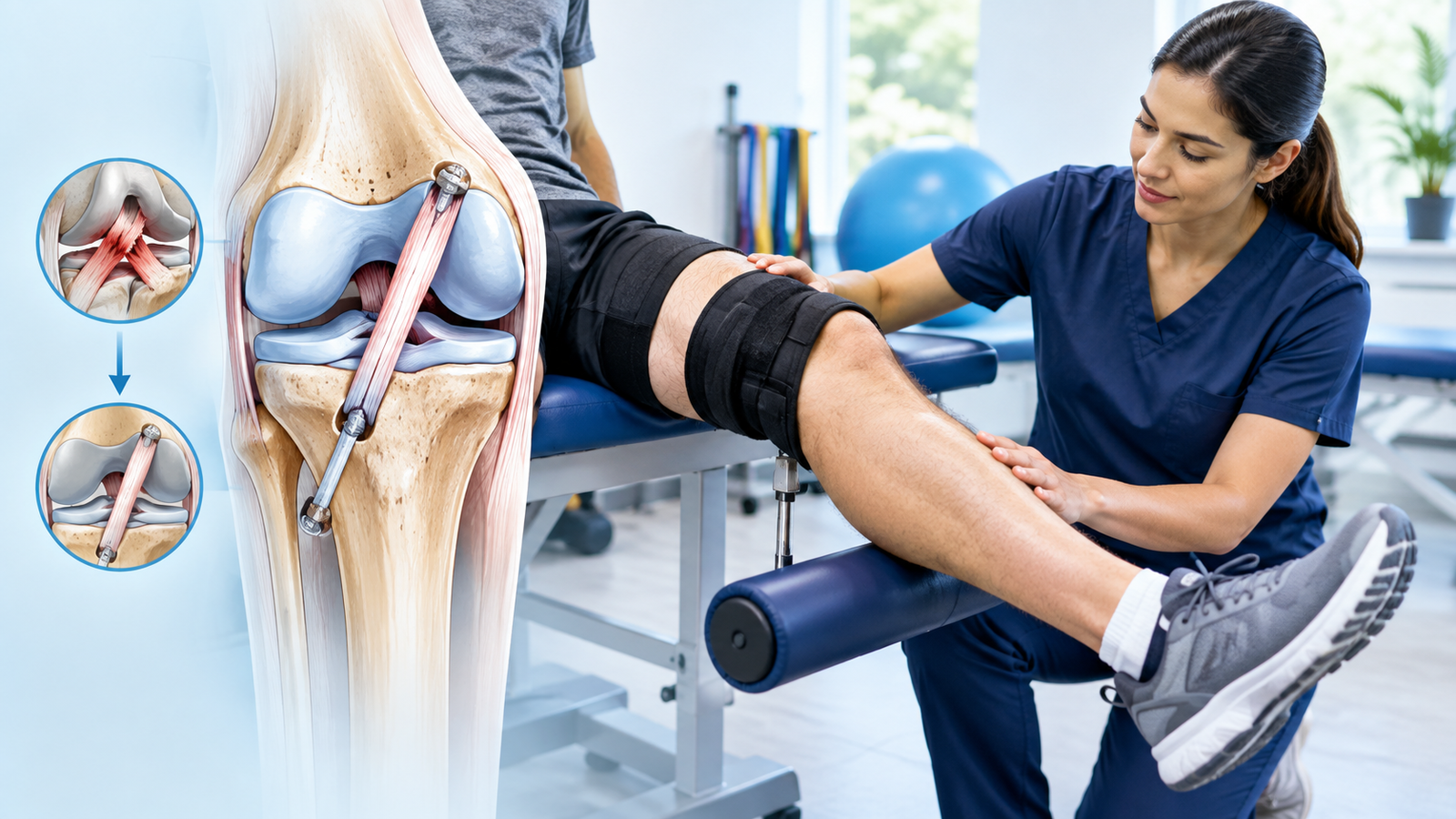
ACL reconstruction is a surgical procedure in which the damaged ACL is replaced with a graft.
The graft may come from the patient’s own tissue, commonly from structures such as the patellar tendon or hamstring tendons, or from another appropriate source.
The goal of reconstruction is to provide a stable structure that can support knee function while the graft gradually undergoes biological healing and remodeling.
Importantly, the reconstructed ligament does not become fully functional immediately after surgery. Rehabilitation must therefore respect the healing process while progressively restoring strength and movement.
Why Is Physiotherapy Important After ACL Reconstruction?
Post-operative physiotherapy is an important part of ACL rehabilitation.
The knee may become swollen and stiff after surgery. At the same time, the quadriceps muscle can lose strength quickly because of pain, swelling and reduced activity.
Without appropriate rehabilitation, patients may experience difficulties with:
- Fully straightening the knee
- Bending the knee
- Walking normally
- Activating the quadriceps
- Climbing stairs
- Squatting
- Balancing on one leg
- Returning to running
- Performing sports-specific movements
A physiotherapist can assess these limitations and develop a progressive rehabilitation program based on the patient’s surgical procedure, symptoms and functional goals.
Main Goals of ACL Reconstruction Rehabilitation
Although the exact rehabilitation program differs between individuals, common goals include:
Early Goals
- Protect the surgical reconstruction
- Control pain and swelling
- Restore knee extension
- Gradually improve knee flexion
- Activate the quadriceps
- Restore safe walking
- Prevent avoidable complications
Intermediate Goals
- Restore lower-limb strength
- Improve knee and hip control
- Develop balance and proprioception
- Improve functional movement
- Progress weight-bearing activities
- Restore confidence in the operated leg
Later Goals
- Develop running capacity when appropriate
- Improve jumping and landing mechanics
- Build agility and coordination
- Perform sport-specific drills
- Prepare for higher-level physical activities
- Establish objective criteria for return to sport
ACL Reconstruction Rehabilitation: What to Expect
ACL rehabilitation is generally progressive rather than based solely on a fixed number of weeks.
The patient’s surgeon and physiotherapist may modify the rehabilitation plan according to:
- Type of graft
- Additional meniscus or cartilage procedures
- Surgical findings
- Knee swelling
- Range of motion
- Muscle strength
- Pain response
- Movement quality
- Functional goals
- Sport or occupational demands
A patient should therefore avoid comparing their recovery directly with another person’s timeline.
Early Physiotherapy After ACL Surgery
The early stage focuses on protecting the knee while restoring basic function.
1. Pain and Swelling Management
Swelling can inhibit quadriceps activation and restrict knee movement.
Depending on the individual’s condition, management may include:
- Appropriate positioning and elevation
- Ice or other clinically appropriate methods
- Gentle movement
- Ankle pumps
- Compression when appropriate
- Gradual activity progression
Pain should be monitored rather than ignored.
A sudden increase in pain or swelling after exercise may indicate that the rehabilitation load needs to be modified.
2. Restoring Knee Extension
Achieving comfortable knee extension is an important early rehabilitation goal.
Loss of extension can interfere with normal walking and may contribute to altered knee mechanics.
Physiotherapy may include carefully selected:
- Passive or assisted extension exercises
- Heel-supported positioning
- Quadriceps activation
- Gentle mobility exercises
Exercises should be performed according to the post-operative protocol provided by the treating team.
3. Improving Knee Flexion
Knee bending is gradually restored as healing allows.
The physiotherapist may use:
- Heel slides
- Assisted knee flexion
- Stationary cycling when appropriate
- Gentle active range-of-motion exercises
The goal is progressive improvement without unnecessarily irritating the knee.
Quadriceps Activation After ACL Reconstruction
One of the common challenges after ACL surgery is reduced quadriceps activation.
This can occur because swelling and pain interfere with the normal communication between the nervous system and muscle.
Common exercises may include:
- Quadriceps setting exercises
- Straight-leg raises when appropriate
- Short-arc quadriceps exercises
- Controlled knee extension exercises
- Progressive resistance training later in rehabilitation
Electrical stimulation may sometimes be considered as an adjunct in selected patients with significant difficulty activating the quadriceps, but it should not replace active exercise and progressive strengthening.
Physiotherapy Exercises After ACL Reconstruction
Exercise selection should be individualized.
Examples commonly used at different stages may include:
Early Exercises
- Ankle pumps
- Quadriceps sets
- Heel slides
- Straight-leg raises when appropriate
- Gentle hip exercises
- Controlled weight-shifting
Progressive Strengthening
As healing and movement improve, rehabilitation may progress toward:
- Mini squats
- Sit-to-stand exercises
- Step-ups
- Bridges
- Leg press
- Hamstring strengthening when appropriate
- Hip abductor strengthening
- Calf raises
Advanced Strengthening
Later rehabilitation may incorporate:
- Progressive resistance training
- Single-leg strengthening
- Split squats
- Lunges
- Controlled step-downs
- Single-leg Romanian deadlift variations
- Plyometric preparation
Not every exercise is suitable for every patient or every stage.
Balance and Proprioception Training
Proprioception refers to the body’s ability to sense the position and movement of a joint.
After ACL injury and reconstruction, balance and neuromuscular control can be affected.
Physiotherapy may gradually introduce:
- Double-leg balance
- Single-leg balance
- Unstable-surface exercises when appropriate
- Reaching activities
- Single-leg functional movements
- Dynamic balance drills
These exercises should become progressively more challenging as the patient’s control improves.
Gait Training After ACL Reconstruction
Walking patterns can change after surgery because of pain, swelling, weakness or restricted movement.
A physiotherapist may assess:
- Step length
- Knee extension during stance
- Weight distribution
- Quadriceps control
- Use of crutches
- Ability to safely progress weight bearing
Crutches should generally be discontinued according to clinical criteria and the surgeon’s instructions rather than simply because a certain number of days has passed.
Strengthening the Hip and Core
ACL rehabilitation should not focus exclusively on the knee.
The hip and trunk influence lower-limb movement during walking, landing, running and cutting activities.
Strengthening may therefore include:
- Gluteal strengthening
- Hip abductor exercises
- Hip extensor exercises
- Core stability exercises
- Pelvic control exercises
Good hip and trunk control can help patients develop better movement strategies during functional activities.
When Can a Patient Start Running?
There is no single running date that applies to every ACL reconstruction patient.
Running should generally be introduced only when the knee demonstrates appropriate readiness.
The physiotherapist may consider:
- Minimal or controlled swelling
- Adequate knee range of motion
- Sufficient quadriceps and hamstring strength
- Good single-leg control
- Appropriate walking mechanics
- Ability to perform preparatory exercises without significant symptoms
The surgeon’s rehabilitation protocol must also be considered.
Returning to running too aggressively can increase stress on a healing knee.
Jumping and Plyometric Training
Plyometric exercises involve rapid stretch-shortening movements such as jumping and hopping.
Examples include:
- Two-leg jumping
- Jump-and-stick landing
- Low-level hopping
- Forward hopping
- Lateral hopping
- Repeated jumps
These exercises should be introduced progressively.
The physiotherapist should evaluate landing quality, not simply whether the patient can complete the exercise.
Important movement factors include:
- Knee alignment
- Hip control
- Trunk position
- Landing symmetry
- Shock absorption
- Ability to decelerate safely
Return-to-Sport Rehabilitation After ACL Reconstruction
Returning to sport is more than simply being able to walk without pain.
A comprehensive return-to-sport program may address:
Strength
Assessment of quadriceps, hamstrings, gluteal and calf strength.
Power
The ability to produce force quickly.
Balance
Single-leg control during increasingly demanding tasks.
Agility
Controlled changes of direction and speed.
Landing Mechanics
Assessment of how the athlete absorbs force after jumping.
Sport-Specific Skills
Progressive drills that reproduce the demands of the individual’s sport.
Psychological Readiness
Confidence and fear of reinjury can influence performance and return to sport.
A return-to-sport decision should ideally consider multiple objective and clinical factors rather than relying solely on elapsed time.
Common Mistakes During ACL Rehabilitation
Some patients unintentionally slow their rehabilitation by progressing too quickly or neglecting important components.
Mistake 1: Doing Too Much Too Soon
Feeling better does not necessarily mean the graft and surrounding tissues are ready for high-level activity.
Mistake 2: Ignoring Swelling
Persistent or increasing swelling can be a sign that the current rehabilitation load is excessive or that further assessment is needed.
Mistake 3: Focusing Only on Knee Exercises
Hip, core and calf strength also contribute to lower-limb function.
Mistake 4: Skipping Strength Training
Regaining muscle strength is a major component of successful functional recovery.
Mistake 5: Returning to Sport Based Only on Time
A calendar date cannot determine whether a particular knee is ready for unrestricted sport.
Mistake 6: Comparing Recovery With Someone Else
Recovery varies according to surgery, injury severity, rehabilitation quality, physical condition and individual healing.
Precautions During ACL Rehabilitation
Patients should follow their surgeon’s post-operative instructions and physiotherapist’s individualized plan.
Seek medical assessment if there is:
- Sudden severe knee pain
- Rapidly increasing swelling
- Calf pain or unusual calf swelling
- Significant redness or warmth
- Fever or wound-related concerns
- Sudden locking or inability to move the knee
- New instability
- Shortness of breath or chest pain
Severe or unexpected symptoms should not simply be treated by increasing or changing exercises.
Home Advice After ACL Reconstruction
A structured home program can complement supervised physiotherapy.
Helpful habits include:
- Complete prescribed exercises consistently.
- Follow weight-bearing instructions.
- Avoid unsupervised high-impact activities during early recovery.
- Monitor swelling after exercise.
- Maintain appropriate nutrition and hydration.
- Follow wound-care instructions provided by the medical team.
- Use prescribed walking aids correctly.
- Attend scheduled rehabilitation sessions.
- Progress activity gradually.
Consistency is often more useful than performing a very large number of exercises occasionally.
How Long Does ACL Reconstruction Rehabilitation Take?
ACL rehabilitation is a long-term process.
Many patients require several months of structured rehabilitation, while return to high-demand pivoting sports can take considerably longer.
The timeline depends on factors such as:
- Type of reconstruction
- Associated meniscus or cartilage injury
- Surgical protocol
- Age and general physical condition
- Muscle strength
- Range of motion
- Swelling and pain
- Rehabilitation adherence
- Sport or occupational demands
- Psychological readiness
The safest approach is generally criterion-based progression rather than assuming that everyone should follow exactly the same timetable.
How Physiotherapy Can Help You After ACL Reconstruction
A professional physiotherapy assessment can help identify limitations that may not be obvious during everyday activities.
A physiotherapist may evaluate:
- Knee range of motion
- Pain and swelling
- Muscle activation
- Lower-limb strength
- Gait
- Balance
- Proprioception
- Functional movement
- Single-leg control
- Jumping and landing mechanics
- Readiness for higher-level activities
Based on the findings, the rehabilitation program can be progressively adjusted.
For patients in Nalbari, Rangia and nearby areas of Assam, professional physiotherapy can provide structured guidance throughout the ACL reconstruction recovery journey—from early mobility and muscle activation to advanced strengthening and functional rehabilitation.
Frequently Asked Questions About ACL Reconstruction Rehabilitation
1. Is physiotherapy necessary after ACL reconstruction?
Physiotherapy is an important component of recovery after ACL reconstruction. It helps restore movement, strength, balance, walking ability and functional capacity while guiding the patient through progressive rehabilitation.
2. When should physiotherapy start after ACL surgery?
Physiotherapy often begins early after surgery, according to the surgeon’s instructions and the specific surgical protocol. Early treatment commonly focuses on swelling control, knee movement, muscle activation and safe mobility.
3. How long does ACL rehabilitation take?
Recovery varies considerably. Many patients undergo several months of rehabilitation, while return to demanding pivoting sports may require a longer period and objective testing before clearance.
4. Can I walk normally after ACL reconstruction?
Most patients progressively regain normal walking, but the timing varies. Walking should be advanced according to pain, swelling, strength, movement quality and the post-operative protocol.
5. When can I start running after ACL reconstruction?
Running should begin when the knee and overall lower limb demonstrate adequate readiness. Strength, range of motion, swelling, balance and movement control should be considered rather than relying only on a particular week after surgery.
6. What exercises are best after ACL reconstruction?
Exercise selection depends on the rehabilitation stage. Common examples include quadriceps activation, heel slides, progressive squats, step-ups, bridges, resistance exercises, balance training and eventually running and plyometric drills.
7. Can physiotherapy reduce knee stiffness after ACL surgery?
Appropriately prescribed mobility exercises and progressive rehabilitation can help improve knee movement. Persistent or worsening stiffness should be assessed by the treating healthcare team.
8. Can I return to sports after ACL reconstruction?
Many patients work toward returning to sport, but return should be based on adequate strength, movement control, functional performance and psychological readiness, along with medical clearance where appropriate.
9. Why is my quadriceps weak after ACL surgery?
Pain, swelling, reduced activity and changes in neuromuscular activation can contribute to quadriceps weakness. Progressive strengthening and appropriate rehabilitation can help restore muscle function.
10. Where can I get ACL rehabilitation physiotherapy in Nalbari or Rangia?
Patients in Nalbari, Rangia and nearby areas can seek professional physiotherapy assessment at the clinics listed below. Rehabilitation should be individualized according to the patient’s surgery, symptoms, functional goals and medical instructions.
Physiotherapy & Rehabilitation in Nalbari and Rangia, Assam
ACL reconstruction rehabilitation requires patience, progressive strengthening and careful monitoring of knee function. If you have undergone ACL reconstruction or are preparing to return to walking, running, gym activities or sports, a professional physiotherapy assessment can help determine your current rehabilitation needs.
Patients from Nalbari, Rangia and nearby areas can visit:
1. Dr. Jehu’s KinetiQure Physiotherapy & Rehabilitation Center
Khatikuchi, Nalbari, Assam – 781369
The clinic provides physiotherapy and rehabilitation services that can be tailored to musculoskeletal and sports-related conditions, including post-operative rehabilitation where clinically appropriate.
2. RevitaFlex PhysioCare – Dhamdhama Branch
Dhamdhama–Santipur Road, Near Dhamdhama Bus Stand, Dhamdhama, Nalbari, Assam – 781349
Patients can seek assessment and individualized physiotherapy management for orthopedic, musculoskeletal and sports rehabilitation needs.
3. RevitaFlex PhysioCare – Dimu Branch
Dimu–Dobok Chariali, Dimu–Baharghat Road, Dimu, Rangia, Assam – 781380
The branch provides access to physiotherapy and rehabilitation services for patients from Dimu, Rangia and surrounding areas.
Home Physiotherapy Visit
For patients who have difficulty travelling after surgery or require rehabilitation at home:
Dr. Jehirul Islam (PT), Consultant Physio
Contact/WhatsApp: +91 7086225195
Email: draaryanphysio@gmail.com
A professional assessment can help determine whether the patient requires mobility training, range-of-motion exercises, progressive strengthening, balance training, gait rehabilitation or more advanced functional rehabilitation.
Patients should bring relevant surgical reports, prescriptions and rehabilitation instructions when available so that physiotherapy can be coordinated appropriately with the treating medical team.
Final Takeaway
ACL reconstruction is not the end of treatment—it is the beginning of a structured rehabilitation journey.
A successful recovery involves much more than reducing pain. The rehabilitation process may include restoring knee movement, rebuilding quadriceps and lower-limb strength, improving balance and neuromuscular control, correcting movement patterns, progressively developing running and jumping capacity, and preparing for the demands of work, daily activities or sport.
The most appropriate rehabilitation plan depends on the individual patient and should progress according to clinical findings and functional readiness.
If you are recovering from ACL reconstruction in Nalbari, Rangia or surrounding areas of Assam, professional physiotherapy assessment can help you understand your current limitations and develop a structured path toward your functional goals.
Clinical Disclaimer
This article is intended for general educational and informational purposes only. It does not replace an individual examination, diagnosis or treatment plan from a qualified healthcare professional. ACL reconstruction rehabilitation varies according to the surgical procedure, graft type, associated injuries, medical history and individual recovery. Exercise selection, intensity, weight-bearing and progression should be determined by the treating surgeon and physiotherapist. Do not begin, stop or significantly modify a post-operative rehabilitation program based solely on this article. Seek prompt medical attention for severe, unusual or worsening symptoms.
 Previous Post
 Next Post