
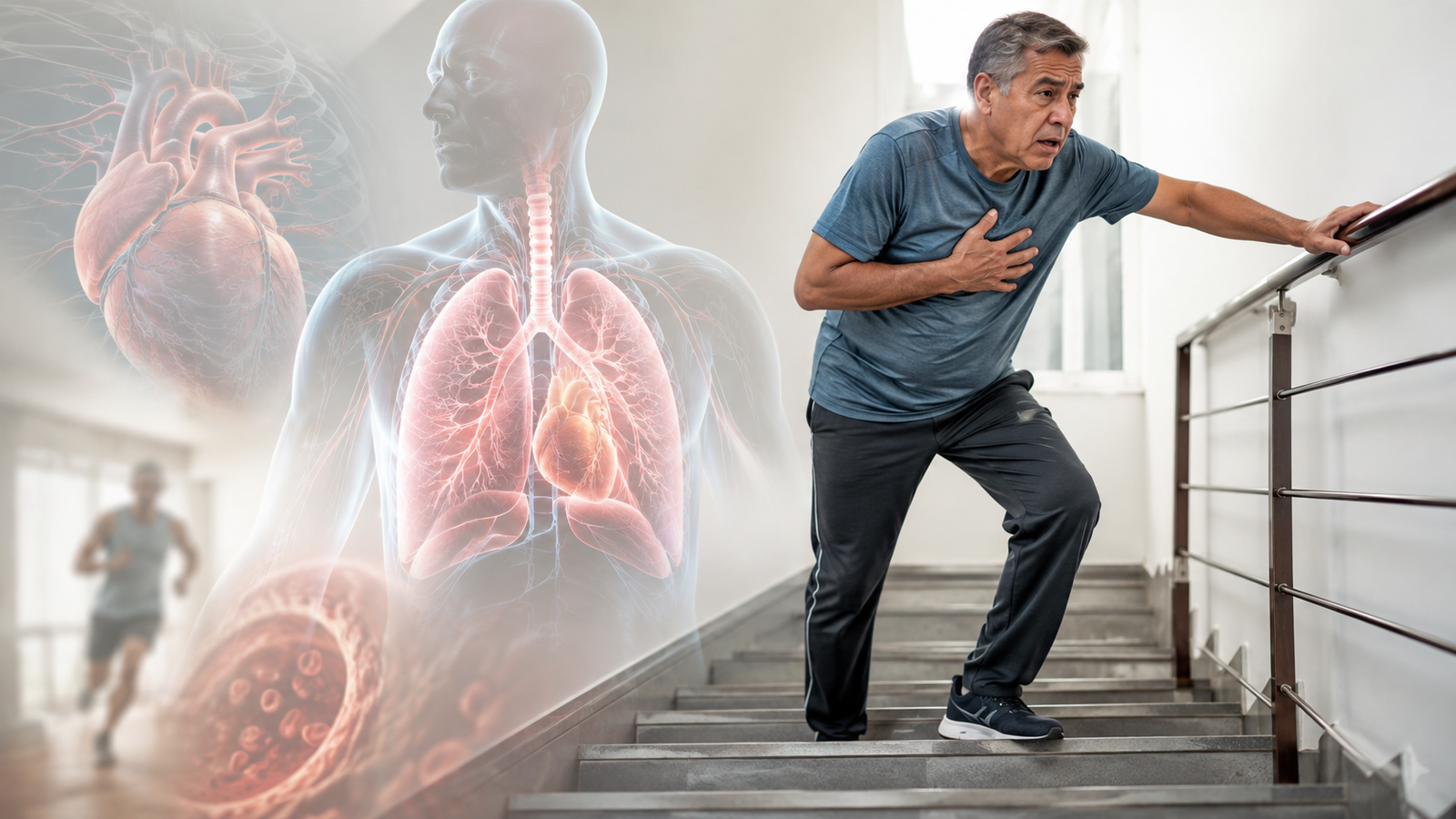
Getting breathless after climbing a few stairs can be caused by low fitness, muscle weakness, deconditioning, breathing problems or underlying heart and lung conditions. Learn the common causes, warning signs, physiotherapy management and safe ways to improve exercise tolerance.
Climbing a few stairs can leave some people breathing harder than expected. While mild breathlessness after physical activity can be completely normal, becoming unusually short of breath after just a few steps may sometimes indicate that your cardiovascular fitness, breathing pattern, muscles, lungs, heart, or overall health need attention.
The good news is that breathlessness is not always a sign of a serious disease. For some people, it can simply reflect a sedentary lifestyle, reduced exercise tolerance, excess body weight, poor breathing mechanics, or loss of muscle strength. However, new, worsening, or disproportionate breathlessness should not be ignored, particularly when it occurs with chest discomfort, dizziness, fainting, palpitations, or severe weakness.
This article explains why you may get breathless while climbing stairs, what factors can contribute to it, when medical evaluation is important, and how physiotherapy and gradual exercise rehabilitation can help improve functional capacity when appropriate.
What Does “Breathlessness” Mean?
Breathlessness, also called shortness of breath or dyspnea, is the uncomfortable feeling that you cannot get enough air or that breathing requires more effort than usual.
It may feel like:
- “I am running out of breath.”
- “I cannot take a deep breath.”
- “My breathing becomes very fast.”
- “My chest feels tight.”
- “I need to stop after climbing a few stairs.”
- “I have to catch my breath before continuing.”
Breathlessness is a symptom rather than a diagnosis. Many different conditions can produce it.
Why Do Stairs Make You Breathless?
Stair climbing is considerably more demanding than walking slowly on a level surface.
When you climb stairs, your body has to:
- Lift your body weight against gravity.
- Produce more muscular force.
- Increase oxygen delivery to working muscles.
- Increase heart rate.
- Increase breathing rate and depth.
- Maintain balance and coordination.
Your muscles therefore require more oxygen and energy. Your heart and lungs respond by working harder.
If your exercise capacity is low, you may reach your personal exertion limit quickly.
Common Reasons You May Get Breathless After a Few Stairs
1. Low Cardiovascular Fitness
One of the most common explanations is deconditioning.
If you spend much of the day sitting, rarely exercise, or have recently reduced your physical activity, your body may become less efficient at handling exertion.
You may notice:
- Increased heart rate during simple activities
- Rapid breathing
- Leg fatigue
- Reduced walking endurance
- Needing frequent rest breaks
Even everyday activities can feel surprisingly demanding when physical conditioning is poor.
Can exercise improve this?
For many otherwise healthy individuals, appropriately progressed aerobic exercise can gradually improve exercise tolerance.
However, exercise should be individualized, especially if breathlessness is unexplained or significant.
2. Sedentary Lifestyle
Modern lifestyles often involve prolonged sitting, limited walking and little structured physical activity.
Over time, inactivity can contribute to:
- Reduced cardiovascular endurance
- Lower muscle strength
- Reduced activity tolerance
- Poor exercise tolerance
- Increased fatigue during daily activities
This can create a cycle:
Less activity → lower fitness → greater breathlessness during activity → avoiding activity → further loss of fitness.
Breaking this cycle gradually can be an important part of rehabilitation.
3. Muscle Weakness and Poor Lower-Limb Endurance
Stair climbing places a substantial demand on the:
- Quadriceps
- Gluteal muscles
- Calf muscles
- Hip stabilizers
- Core muscles
If these muscles are weak or fatigue quickly, climbing stairs may feel much harder.
Sometimes people interpret the resulting heavy breathing as a purely “lung problem,” when muscular fatigue and overall deconditioning may also contribute.
A physiotherapist can assess functional strength and endurance using appropriate clinical tests.
4. Excess Body Weight
Carrying additional body mass increases the physical workload during movement.
Stair climbing becomes particularly demanding because the body must repeatedly move its mass upward against gravity.
Higher body weight may therefore contribute to:
- Increased energy expenditure
- Greater cardiovascular demand
- Increased joint loading
- Faster muscle fatigue
- Reduced exercise tolerance
Weight management, physical activity, strengthening and cardiovascular conditioning may be useful components of a broader health plan.
5. Inefficient Breathing Pattern
Some people develop inefficient breathing habits, particularly during physical activity or periods of stress.
For example, a person may:
- Breathe very rapidly
- Hold their breath while exerting
- Use excessive upper-chest movement
- Have poor coordination between breathing and movement
Physiotherapy may include breathing retraining when clinically appropriate.
The goal is not simply to “take deeper breaths,” but to develop a more efficient and comfortable breathing strategy.
6. Asthma and Other Airway Conditions
Breathlessness during exercise can sometimes be related to airway problems.
Asthma, for example, may cause:
- Wheezing
- Coughing
- Chest tightness
- Shortness of breath
- Difficulty exercising
Some people experience symptoms mainly during or after exercise.
If you repeatedly develop these symptoms, medical assessment is important because appropriate diagnosis and treatment may be needed.
7. Chronic Lung Conditions
Conditions affecting the lungs can reduce exercise tolerance.
Examples include:
- Chronic obstructive pulmonary disease (COPD)
- Bronchiectasis
- Interstitial lung disease
- Certain consequences of previous respiratory infections
People with chronic respiratory conditions may become breathless during activities such as:
- Walking uphill
- Climbing stairs
- Carrying groceries
- Bathing
- Household work
For these individuals, pulmonary rehabilitation may be an important part of management.
8. Anemia
Anemia occurs when the blood has a reduced ability to carry oxygen, commonly because hemoglobin levels are low.
A person with anemia may experience:
- Fatigue
- Weakness
- Reduced exercise tolerance
- Breathlessness during exertion
- Dizziness
- Pale appearance in some cases
If breathlessness is accompanied by unusual fatigue or weakness, a doctor may consider blood tests to identify possible causes.
Physiotherapy alone cannot correct anemia; the underlying medical cause needs appropriate management.
9. Heart-Related Problems
The heart plays a central role in delivering oxygen-rich blood to working muscles.
Certain cardiovascular conditions can cause exertional breathlessness.
Possible associated symptoms include:
- Chest pressure or discomfort
- Palpitations
- Dizziness
- Unusual fatigue
- Swelling of the legs
- Breathlessness when lying flat
- Breathlessness that is progressively worsening
These symptoms warrant medical evaluation rather than simply increasing exercise independently.
10. Anxiety, Stress and Breathing Dysregulation
Emotional stress and anxiety can influence breathing.
During periods of anxiety, some people begin breathing faster or more shallowly. This can make the sensation of breathlessness more noticeable.
Importantly, not every episode of breathlessness should be attributed to anxiety.
New or unexplained symptoms should first be assessed appropriately, particularly if they occur with physical exertion.
11. Recent Illness or Reduced Activity After Hospitalization
After an illness, surgery, prolonged bed rest, or hospitalization, physical capacity can decrease significantly.
Even if the original condition has improved, you may notice:
- Reduced walking distance
- Muscle weakness
- Easy fatigue
- Breathlessness with exertion
- Difficulty climbing stairs
A structured rehabilitation programme can help rebuild strength and endurance when medically appropriate.
Is It Normal to Get Breathless While Climbing Stairs?
Some increase in breathing and heart rate during stair climbing is normal.
The important question is whether the response is proportionate to the activity and your current fitness level.
For example, a healthy but deconditioned person may breathe heavily after several flights of stairs and recover after a short rest.
More concerning patterns include:
- Breathlessness after very minimal activity
- Breathlessness that is new
- Symptoms becoming progressively worse
- Breathlessness occurring at rest
- Breathlessness accompanied by chest pain
- Fainting or near-fainting
- Blue or grey lips
- Severe wheezing
- New confusion
- Significant palpitations
When Should You Seek Medical Attention?
Seek urgent medical help if breathlessness is:
- Sudden and severe
- Associated with chest pain or pressure
- Associated with fainting or severe dizziness
- Accompanied by blue/grey lips or marked difficulty breathing
- Associated with confusion
- Rapidly worsening
- Occurring at rest and causing significant distress
These symptoms can sometimes indicate a serious medical problem.
Do not attempt to treat unexplained severe breathlessness with exercise or physiotherapy alone.
How Is Breathlessness Evaluated?
The assessment depends on the person’s symptoms, age, medical history and functional limitations.
A healthcare professional may consider:
Medical history
Questions may include:
- When did the breathlessness begin?
- Does it occur only during exercise?
- Is it getting worse?
- Do you have cough or wheezing?
- Do you experience chest discomfort?
- Do you smoke or have a history of respiratory disease?
- Have you recently been ill or hospitalized?
- What activities trigger symptoms?
Physical assessment
Depending on the situation, assessment may include:
- Heart rate
- Blood pressure
- Respiratory rate
- Oxygen saturation
- Breathing pattern
- Exercise tolerance
- Muscle strength
- Functional mobility
- Walking capacity
Further medical investigations may be required when indicated.
What Role Does Physiotherapy Play in Breathlessness?
Physiotherapy can play an important role when breathlessness is associated with deconditioning, reduced exercise capacity, respiratory conditions, muscle weakness, impaired mobility or functional limitations.
The first step is identifying whether physiotherapy is appropriate and whether medical assessment is required.
Physiotherapy Assessment
A physiotherapist may evaluate:
1. Exercise tolerance
How much activity can you perform before significant symptoms develop?
2. Functional mobility
Activities may include:
- Walking
- Sit-to-stand
- Stair climbing
- Transfers
- Daily activities
3. Muscle strength
Weakness of the lower limbs can significantly affect stair-climbing ability.
4. Breathing pattern
The physiotherapist may observe:
- Respiratory rate
- Chest movement
- Accessory muscle use
- Breathing coordination
5. Exercise response
Where appropriate and within the clinician’s scope, response to exercise may be monitored using parameters such as heart rate, symptoms and oxygen saturation.
Physiotherapy Management for Exercise-Related Breathlessness
The programme should be individualized rather than following a one-size-fits-all routine.
1. Breathing Exercises
Depending on the individual’s condition, a physiotherapist may teach breathing strategies such as:
- Diaphragmatic breathing
- Controlled breathing
- Pursed-lip breathing
- Breathing coordination during activity
These techniques can be particularly useful in selected respiratory rehabilitation programmes.
2. Aerobic Conditioning
Gradual cardiovascular training may include:
- Walking
- Stationary cycling
- Low-impact aerobic activity
- Treadmill walking
- Other suitable endurance exercises
The intensity and duration should be progressed according to the individual’s condition and tolerance.
3. Lower-Limb Strengthening
Because stair climbing heavily involves the lower limbs, strengthening may focus on:
- Sit-to-stand exercises
- Supported squats
- Step-ups
- Calf raises
- Hip strengthening
- Functional strengthening
Exercises should be modified for people with joint pain, neurological conditions, balance problems or significant weakness.
4. Functional Stair Training
For someone whose main difficulty is climbing stairs, rehabilitation may eventually incorporate graded stair practice.
This may involve:
- Practising weight shifting
- Strengthening the legs
- Improving balance
- Practising step-ups
- Gradually increasing repetitions
- Progressing stair height or duration
Safety should always come first.
What Can You Do at Home?
If you have already been medically assessed and there is no contraindication to exercise, several habits may help improve general exercise tolerance.
Start gradually
Do not suddenly begin intense exercise because you want to “increase lung capacity.”
Instead, begin with manageable activity and progress gradually.
Walk regularly
Short, consistent walks may be more useful than occasional intense workouts.
Avoid prolonged sitting
Break up long periods of sitting with regular movement.
Practise your prescribed breathing exercises
If a physiotherapist has taught you breathing techniques, practise them consistently.
Strengthen your legs
Functional exercises such as sit-to-stand may be useful when appropriate.
Pace yourself
During activity, avoid starting too fast and exhausting yourself immediately.
Maintain adequate hydration and nutrition
General health, nutrition and hydration can influence energy levels and exercise tolerance.
How to Improve Stair-Climbing Endurance Safely
A useful rehabilitation principle is:
Consistency first, intensity later.
For example, rather than repeatedly pushing yourself until you are extremely breathless:
- Begin with comfortable activity.
- Monitor how your body responds.
- Allow adequate recovery.
- Repeat regularly.
- Gradually increase duration.
- Later increase intensity or functional difficulty.
The appropriate progression depends on the individual’s health and fitness.
What Should You Avoid?
Avoid:
- Ignoring progressively worsening breathlessness
- Starting strenuous exercise without evaluation when symptoms are unexplained
- Exercising through chest pain
- Holding your breath during strengthening exercises
- Comparing your exercise tolerance with another person’s
- Assuming every episode of breathlessness is caused by poor fitness
- Using breathing exercises as a substitute for medical treatment when an underlying disease is suspected
Breathlessness and Physiotherapy: The Bigger Picture
Getting breathless after climbing stairs is not necessarily a sign that your lungs are “weak.”
Your ability to climb stairs depends on the coordinated function of several systems:
Heart + lungs + blood circulation + muscles + nervous system + body composition + breathing pattern + physical conditioning
If one or more of these factors is impaired, stair climbing can become difficult.
This is why a proper assessment is more useful than simply trying random breathing exercises.
When Should You Consider Physiotherapy?
Physiotherapy assessment may be helpful if:
- You become unusually fatigued during routine activities.
- Your walking endurance has decreased.
- You have difficulty climbing stairs because of weakness or deconditioning.
- You are recovering from an illness or prolonged inactivity.
- You have a diagnosed respiratory condition and have been referred for rehabilitation.
- You want to safely improve cardiovascular and functional fitness.
- Muscle weakness or poor mobility contributes to your activity limitation.
A physiotherapist can help determine whether rehabilitation is appropriate and develop a progressive programme based on your functional capacity.
Physiotherapy & Rehabilitation in Nalbari and Rangia, Assam
If you live in Nalbari, Rangia, Dhamdhama, Dimu or nearby areas and frequently experience breathlessness or reduced tolerance during walking, stair climbing or daily activities, professional assessment can help identify whether physical deconditioning, muscle weakness, breathing-pattern problems or functional limitations may be contributing.
However, unexplained or significant breathlessness should be medically evaluated first when indicated. Physiotherapy is not a replacement for diagnosis or treatment of heart, lung, blood or other medical conditions.
Patients from Nalbari, Rangia and nearby areas can visit:
1. Dr. Jehu’s KinetiQure Physiotherapy & Rehabilitation Center
Khatikuchi, Nalbari, Assam – 781369
Suitable physiotherapy and rehabilitation assessment may help evaluate exercise tolerance, functional mobility, muscle strength, breathing patterns and activity-related limitations.
2. RevitaFlex PhysioCare – Dhamdhama Branch
Dhamdhama–Santipur Road, Near Dhamdhama Bus Stand, Dhamdhama, Nalbari, Assam – 781349
Patients experiencing difficulty with everyday activities such as walking, stair climbing or physical exertion can seek an individualized physiotherapy assessment where appropriate.
3. RevitaFlex PhysioCare – Dimu Branch
Dimu–Dobok Chariali, Dimu–Baharghat Road, Dimu, Rangia, Assam – 781380
Patients from Dimu, Rangia and surrounding areas may seek professional rehabilitation guidance for reduced physical endurance, weakness and functional limitations.
Home Physiotherapy Visit
Dr. Jehirul Islam (PT), Consultant Physio
Contact/WhatsApp: +91 7086225195
Email: draaryanphysio@gmail.com
A home physiotherapy assessment can be particularly useful for individuals who have difficulty travelling to a clinic because of reduced mobility, weakness or limited exercise tolerance.
Frequently Asked Questions
1. Why do I get breathless after climbing only a few stairs?
Common possibilities include low cardiovascular fitness, deconditioning, muscle weakness, excess body weight and inefficient breathing. However, heart, lung, blood and other medical conditions can also cause exertional breathlessness, so persistent or unexplained symptoms should be assessed.
2. Is getting breathless while climbing stairs normal?
Breathing faster during stair climbing is normal because your body’s demand for oxygen increases. However, severe, new or disproportionate breathlessness is not something to automatically dismiss as poor fitness.
3. Can physiotherapy help with breathlessness?
Physiotherapy can help selected patients through exercise conditioning, breathing retraining, strengthening, functional training and pulmonary rehabilitation. The appropriate approach depends on the underlying cause.
4. Can lack of exercise make me breathless?
Yes. Physical inactivity can reduce cardiovascular and muscular fitness, making ordinary activities feel more demanding.
5. Can weak leg muscles make stair climbing difficult?
Yes. Stair climbing requires substantial strength from the quadriceps, gluteal muscles and calf muscles. Weakness can increase fatigue and make the activity feel more strenuous.
6. What breathing exercises are useful for breathlessness?
Depending on the individual’s condition, techniques such as diaphragmatic breathing, controlled breathing and pursed-lip breathing may be taught. The correct technique should depend on the person’s diagnosis and clinical assessment.
7. When is breathlessness an emergency?
Sudden severe breathlessness, especially when accompanied by chest pain, fainting, confusion, blue/grey lips or rapidly worsening symptoms, requires urgent medical attention.
8. How can I improve my stair-climbing endurance?
Once serious medical causes have been appropriately excluded, gradual walking, aerobic conditioning, lower-limb strengthening and progressive functional training can improve exercise tolerance in many people.
9. Should I exercise if I become breathless?
Mild breathlessness can occur during normal exercise, but unexplained, severe or worsening breathlessness should be evaluated before beginning strenuous exercise. Stop exercising and seek appropriate care if concerning symptoms occur.
10. Can home physiotherapy help someone who gets breathless while walking?
Home physiotherapy may be appropriate for some people, particularly when mobility limitations make clinic visits difficult. A physiotherapist can assess functional capacity and develop an individualized rehabilitation plan when medically appropriate.
Key Takeaway
Getting slightly breathless after climbing stairs can be a normal response to physical exertion—but becoming unusually breathless after only a few steps deserves attention.
The cause may be something relatively simple, such as deconditioning, muscle weakness or poor exercise tolerance, but breathlessness can also occur with respiratory, cardiovascular, blood-related and other medical conditions.
The most appropriate approach is therefore to understand why the breathlessness is happening before deciding how to treat it.
If appropriate, physiotherapy can contribute through breathing strategies, aerobic conditioning, muscle strengthening, functional training and gradual rehabilitation—with exercise intensity tailored to the individual’s health and capacity.
Clinical Disclaimer
This article is intended for general educational purposes only and does not constitute a medical diagnosis or individualized treatment plan. Breathlessness can have many causes, including conditions requiring medical evaluation. New, unexplained, severe or worsening shortness of breath—especially when associated with chest pain, fainting, confusion, blue/grey lips or severe breathing difficulty—requires prompt medical attention. Physiotherapy and exercise should be undertaken according to the individual’s clinical condition and professional assessment.