

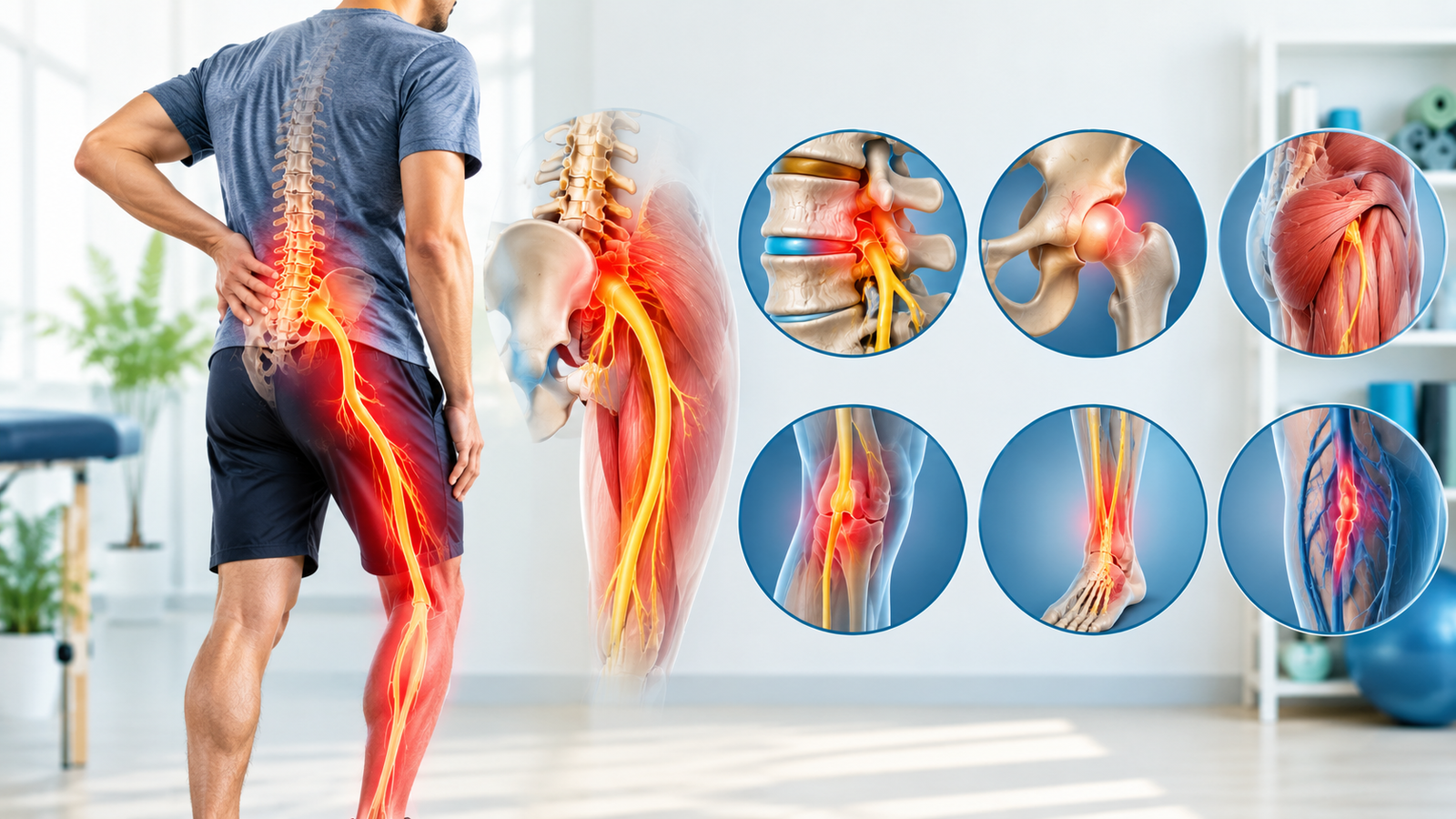
Not every shooting leg pain is sciatica. Discover seven conditions that can mimic sciatic nerve pain, how physiotherapists assess radiating leg symptoms, which warning signs require medical attention, and how individualised physiotherapy may help. Find physiotherapy and rehabilitation options in Nalbari and Rangia, Assam.
A sudden shooting pain travels from your lower back into your buttock. Sometimes it spreads down your thigh, calf, or even your foot. You may also experience tingling, burning, numbness, or an electric-shock-like sensation when walking, sitting, bending, or standing.
Someone tells you that it must be sciatica. You search online, watch a few videos, and start trying exercises designed for sciatic nerve pain.
But what if the diagnosis is not correct?
Not every shooting leg pain is sciatica. Although sciatica is a common explanation for pain radiating down the leg, similar symptoms can arise from several other conditions, including problems involving the hip, peripheral nerves, muscles, blood vessels, or other structures in the lower back and pelvis.
This distinction matters because the most appropriate treatment depends on what is causing your symptoms. An exercise that helps one person may be ineffective or aggravating for another.
The phrase “Your Sciatica Is Fake?” is intended to challenge a common assumption, not to suggest that your pain is imaginary. Your symptoms are real, even when the cause has not been correctly identified.
For patients experiencing shooting leg pain, lower back pain, tingling, or numbness, a careful clinical assessment can help identify the likely source of the problem and determine whether physiotherapy is appropriate.
In this guide, we explain what sciatica actually means, how it differs from other causes of leg pain, which warning signs require urgent medical attention, and how physiotherapy may help.
What Is Sciatica?
Sciatica describes pain associated with irritation or compression of the sciatic nerve or its contributing nerve roots, usually producing symptoms along part of the path from the lower back through the buttock and into the leg.
The sciatic nerve is the largest nerve in the body. It forms from nerve roots in the lower spine and travels through the buttock and down the back of the leg, with branches supplying the lower leg and foot.
When the relevant nerve roots or sciatic nerve become irritated, symptoms may include:
- Sharp, shooting, or electric-like pain travelling down one leg.
- Burning or tingling sensations.
- Numbness in part of the leg or foot.
- Symptoms that extend below the knee.
- Weakness in certain leg or foot movements in more significant cases.
Some people experience lower back pain alongside their leg symptoms, while others mainly notice pain in the buttock or leg.
Sciatica is usually associated with one leg, although symptoms on both sides can occur in certain conditions and require careful assessment.
Is Sciatica the Same as a Slipped Disc?
No. A slipped disc is a common term for a spinal disc problem, often involving a disc herniation. A herniated disc can irritate or compress a nearby nerve root and cause sciatica, but not everyone with a herniated disc develops symptoms.
Likewise, sciatica can have causes other than a herniated disc, such as narrowing around the spinal nerves.
The terms should not be used interchangeably:
- Sciatica: A pattern of symptoms associated with the sciatic nerve or its nerve roots.
- Lumbar radiculopathy: A condition in which a nerve root in the lower spine is affected, potentially causing radiating pain, altered sensation, or muscle weakness.
- Disc herniation: A structural change in a spinal disc that may or may not cause symptoms.
A clinical assessment helps determine which description best fits your presentation.
Why Not Every Shooting Leg Pain Is Sciatica
Pain that travels down the leg does not automatically mean that the sciatic nerve is responsible.
Different tissues can produce overlapping symptoms. The location, pattern, triggers, associated signs, and physical examination findings help a clinician distinguish between possible causes.
For example, a person with hip joint pain may feel discomfort in the buttock or thigh. Someone with a peripheral nerve problem may experience tingling in the foot. Another person may have pain originating from the lower back without clear evidence of nerve-root involvement.
The following conditions are important possibilities to consider.
7 Conditions That Can Mimic Sciatica
1. Lumbar Radiculopathy From a Herniated Disc
A herniated lumbar disc may irritate a nerve root as it exits the lower spine.
Symptoms can include radiating leg pain, pins and needles, numbness, and sometimes muscle weakness. Coughing, sneezing, or certain spinal movements may aggravate symptoms in some people.
However, not every disc herniation causes pain, and not every case of radiating leg pain is caused by a disc.
How it differs from other causes: The distribution of pain, changes in sensation, muscle strength, reflexes, and findings from a neurological examination can help identify possible nerve-root involvement.
Imaging may be appropriate in selected cases, but an MRI finding must be interpreted alongside symptoms and examination results.
2. Piriformis-Related or Deep Gluteal Pain
The piriformis is a small muscle located deep in the buttock. The sciatic nerve passes close to this muscle, although the exact anatomical relationship varies between individuals.
Problems involving the deep gluteal region may produce buttock pain and sometimes symptoms that travel down the leg.
People may notice discomfort when sitting for long periods, climbing stairs, running, or performing certain hip movements.
The term deep gluteal syndrome describes non-spinal problems involving structures that may irritate the sciatic nerve in the buttock region. Piriformis-related irritation is one possible explanation, but it is not the cause of every case of buttock pain with leg symptoms.
Why assessment matters: Hip movement, local tenderness, symptom reproduction, neurological findings, and the history of the problem may help distinguish deep gluteal pain from lumbar nerve-root irritation.
There is no single home test that reliably confirms piriformis syndrome.
3. Sacroiliac Joint-Related Pain
The sacroiliac joints connect the sacrum at the base of the spine to the pelvic bones.
Pain arising from this region is often felt around the lower back, buttock, or upper thigh. Some people report pain spreading farther down the leg, although this pattern alone does not establish the sacroiliac joint as the cause.
Sacroiliac joint-related pain can overlap with lumbar and hip conditions, making diagnosis challenging.
A clinician may use a combination of examination findings and appropriate tests to determine whether this region is a likely contributor.
Important: Pain near the sacroiliac joint does not automatically mean the joint is misaligned or that it needs to be manipulated into place.
4. Hip Joint Problems
Hip conditions can cause pain in the groin, buttock, outer hip, or thigh. In some cases, the discomfort may be mistaken for sciatica.
Possible causes include:
- Hip osteoarthritis.
- Tendon-related pain around the hip.
- Hip joint irritation.
- Certain sports-related injuries.
- Other conditions affecting the surrounding soft tissues.
Hip osteoarthritis may cause stiffness after rest, reduced hip movement, and discomfort during walking or putting on footwear. Tendon-related pain may be more noticeable with particular activities or positions.
A useful distinction: Hip joint pain often changes with hip movement or weight-bearing, whereas nerve-root pain may be accompanied by tingling, altered sensation, or neurological weakness. These are tendencies, not definitive rules.
A proper assessment is important because hip and spinal conditions can occur together.
5. Peripheral Nerve Entrapment
Nerves travel through several regions of the leg and can become irritated or compressed away from the spine.
For example, the common fibular (peroneal) nerve passes near the outer side of the knee. Problems affecting this nerve can cause altered sensation along part of the lower leg or top of the foot and may weaken the ability to lift the foot.
Other peripheral nerve problems can cause burning, tingling, numbness, or pain in different distributions.
These symptoms may resemble sciatica, but the affected nerve and likely cause may be different.
Why it matters: Treatment depends on the location and severity of the nerve problem. Persistent numbness or new muscle weakness should not be managed with stretching alone.
6. Hamstring or Other Muscle-Related Pain
Muscle injuries and tendon problems around the buttock and back of the thigh can produce pain that resembles nerve-related symptoms.
Hamstring problems, for example, may cause discomfort during running, bending forward, climbing stairs, or sitting on a firm surface.
Muscle-related pain may be associated with a recent increase in activity, a sudden movement, or a sports injury. It does not usually produce the same neurological pattern as a nerve-root disorder, although symptoms can overlap.
What helps distinguish it: The history of the injury, tenderness, resisted muscle testing, movement assessment, and neurological examination may help clarify the cause.
Aggressive hamstring stretching is not appropriate for every person with pain behind the thigh. If symptoms are caused by an irritated nerve or an acute muscle injury, the wrong stretching approach may aggravate them.
7. Vascular Problems, Including Deep Vein Thrombosis
Not all leg pain comes from nerves, joints, or muscles.
Circulatory problems can also cause lower-limb discomfort. One important condition is deep vein thrombosis (DVT), in which a blood clot forms in a deep vein, usually in the leg.
Possible warning signs include:
- New swelling in one leg.
- Warmth or redness in the affected area.
- Pain or tenderness in the calf or thigh.
- A noticeable difference in the size of one leg compared with the other.
DVT does not always produce every typical symptom.
Seek urgent medical assessment if you suspect a blood clot. Do not attempt to treat unexplained unilateral leg swelling with massage, vigorous exercise, or routine physiotherapy before medical assessment.
Sudden breathlessness, chest pain, coughing up blood, or collapse alongside possible DVT symptoms requires emergency medical care.
This is an important reason not to assume that every painful leg needs nerve stretches or back exercises.
How Can You Tell Whether Your Leg Pain Is Sciatica?
You cannot reliably confirm sciatica from the sensation of pain alone.
A shooting, burning, or tingling sensation may suggest nerve involvement, but the same words can describe different conditions.
Instead of focusing on one symptom, consider the overall pattern.
Signs That May Support Sciatica or Nerve-Root Irritation
- Pain travels from the lower back or buttock into the leg.
- Symptoms extend below the knee or toward the foot.
- Tingling or altered sensation accompanies the pain.
- Certain spinal movements reproduce or change the symptoms.
- Examination reveals changes in strength, sensation, or reflexes consistent with a particular nerve root.
Not every person with sciatica has all these features.
Signs That May Point Toward Another Cause
- Pain is concentrated around the groin and changes substantially with hip movement.
- Buttock pain is strongly associated with local pressure or particular hip positions.
- Symptoms began after a specific muscle injury.
- Numbness follows the distribution of a particular peripheral nerve.
- One leg becomes newly swollen, warm, or red.
- Pain occurs with exertion in a pattern that raises concern about circulation.
These clues do not establish a diagnosis by themselves. Several conditions can coexist, and some serious problems initially produce subtle symptoms.
The safest approach is to obtain a clinical assessment when pain is persistent, recurring, severe, or associated with neurological symptoms.
How Physiotherapists Assess Shooting Leg Pain
A good physiotherapy assessment does more than identify where you feel pain. It looks at the pattern of symptoms and the structures or conditions that could explain them.
1. Detailed Symptom History
Your physiotherapist may ask:
- When did the pain begin?
- Did it start suddenly or develop gradually?
- Does it travel below the knee?
- Do you experience tingling, numbness, or weakness?
- Which activities aggravate or relieve the pain?
- Did the symptoms follow an injury or a change in physical activity?
- Have you experienced similar episodes before?
- Do you have relevant medical conditions or recent surgery?
The answers help establish which diagnoses are plausible and whether further medical assessment is needed.
2. Neurological Examination
When nerve involvement is suspected, the assessment may include checks of:
- Muscle strength in the legs and feet.
- Sensation in relevant areas of the lower limbs.
- Reflexes, where appropriate.
- Walking pattern and functional movement.
- Changes in symptoms during selected movements.
A physiotherapist may also perform clinically appropriate nerve-tension tests, such as the straight leg raise, when indicated.
These tests must be interpreted together with the history and other findings. A positive test alone does not prove that a person has sciatica.
3. Lumbar Spine, Hip, and Functional Assessment
The clinician may assess spinal movement, hip mobility, muscle function, balance, and activities such as walking, sitting, standing, or climbing stairs.
The purpose is to identify findings that help distinguish a spinal nerve problem from hip-related pain, muscular problems, or other possible causes.
4. Screening for Conditions Requiring Medical Referral
Physiotherapists should consider warning signs and determine when medical investigation or urgent referral is necessary.
Imaging, blood tests, vascular assessment, or specialist evaluation may be appropriate depending on the suspected condition.
An MRI is not routinely required for every episode of sciatica. It may be considered when serious pathology is suspected, neurological symptoms are severe or progressing, or the result is likely to change management.
Physiotherapy Management for Sciatica and Sciatica-Like Pain
Physiotherapy treatment should follow the assessment rather than assume that every patient needs the same exercises.
When the symptoms are consistent with uncomplicated sciatica or lumbar nerve-root irritation, treatment may involve several approaches.
1. Education and Activity Modification
Understanding your symptoms can help you make informed decisions about daily activities.
Your physiotherapist may help you identify movements or positions that aggravate symptoms and suggest practical modifications.
For example:
- Alternate between sitting, standing, and walking.
- Avoid remaining in one position for prolonged periods if it worsens symptoms.
- Temporarily adjust heavy lifting or repetitive bending when necessary.
- Continue tolerable daily activities rather than automatically stopping all movement.
- Gradually return to tasks as your symptoms and function allow.
The goal is not to eliminate every sensation of discomfort before moving. It is to find an appropriate level of activity without provoking significant or sustained worsening.
2. Individualised Therapeutic Exercise
Exercises may help improve physical capacity, confidence in movement, and tolerance for daily activities.
Depending on the assessment, a programme may include:
- Gentle lumbar movement exercises.
- Trunk and hip strengthening.
- Walking or other suitable aerobic activity.
- Mobility exercises where restriction is relevant.
- Functional training for lifting, bending, or standing.
- Selected nerve-mobility exercises when clinically appropriate.
There is no single exercise that treats every case of sciatica.
Some people respond well to particular spinal movements, while others need a different approach. An exercise should not be continued simply because it is labelled a sciatica exercise online.
3. Nerve-Mobility Exercises When Appropriate
Nerve-mobility exercises, sometimes called nerve gliding or nerve flossing, aim to encourage controlled movement of a nerve relative to surrounding tissues.
They may be considered in selected cases, but they are not suitable for every type or severity of nerve problem.
The technique, range, and dosage matter. Aggressive nerve stretching can increase symptoms in some people.
A physiotherapist can determine whether these exercises are appropriate and teach you how to perform them safely.
4. Strengthening and Functional Rehabilitation
Once symptoms allow, progressive strengthening can help restore physical capacity and support a return to usual activities.
Exercises may target the trunk, hips, and lower limbs according to the individual’s needs.
Progression should be based on symptom response, strength, movement quality, and function—not on a fixed timeline that promises recovery by a certain date.
5. Manual Therapy as an Adjunct
Selected manual therapy techniques may help some patients manage symptoms when used alongside education and exercise.
However, manual therapy is not essential for everyone and should not replace appropriate rehabilitation or medical assessment when indicated.
Treatment should be explained clearly, adapted to the patient’s condition, and reviewed according to progress.
6. Coordination With Medical Care
Physiotherapy may be part of a broader treatment plan involving a physician, orthopaedic specialist, neurologist, or other healthcare professional.
If examination findings suggest a serious condition, progressive neurological impairment, or a cause outside the scope of routine physiotherapy, referral is an important part of safe care.
The priority is to identify the likely cause of the symptoms and select appropriate treatment—not to label every painful leg as sciatica.
Safe Home Advice for Shooting Leg Pain
If your symptoms are mild and there are no warning signs, several general strategies may help while you arrange assessment if needed.
Keep Moving Within Your Tolerance
Short, comfortable walks may help you maintain activity when tolerated.
Avoid prolonged bed rest unless a healthcare professional has advised otherwise for a specific reason. At the same time, do not force yourself through severe pain or progressive neurological symptoms.
Adjust Sitting and Sleeping Positions
There is no single position that is best for everyone.
You may find it helpful to:
- Change position regularly.
- Use a chair that supports comfortable sitting.
- Avoid positions that consistently increase leg symptoms.
- Try a pillow between the knees when side-sleeping if it improves comfort.
- Use a pillow under the knees when lying on your back if that feels better.
These are comfort strategies, not treatments that correct a confirmed structural problem.
Avoid Aggressive Stretching
Do not repeatedly force your leg into a stretch to reproduce or eliminate shooting pain.
If stretching increases tingling, numbness, radiating pain, or weakness, stop and seek professional advice.
Use Heat or Cold Carefully
Some people find gentle heat or a cold pack soothing. Neither method identifies or necessarily treats the underlying cause.
Protect your skin, avoid extreme temperatures, and do not apply heat or ice to areas with reduced sensation or impaired circulation without appropriate advice.
Do Not Ignore New Weakness or Numbness
A leg that feels painful is different from a leg that is losing strength or function.
New foot drop, difficulty lifting the front of the foot, progressive weakness, or increasing sensory loss requires prompt medical assessment.
Warning Signs: When Leg Pain Needs Urgent Medical Attention
Some causes of shooting leg pain need urgent evaluation rather than a home exercise programme.
Seek Emergency Care If You Develop:
- New loss of bladder or bowel control, or difficulty passing urine associated with concerning back or leg symptoms.
- Numbness around the groin, genitals, or the area that would contact a saddle.
- Rapidly progressing or severe weakness in one or both legs.
- Severe radiating back pain accompanied by new neurological changes.
- Sudden chest pain or shortness of breath, particularly when a blood clot is possible.
These symptoms can indicate serious medical conditions, including cauda equina syndrome or other neurological or vascular emergencies.
Seek Urgent Medical Assessment If You Have:
- New swelling, warmth, or redness in one leg.
- Fever or feeling seriously unwell alongside significant back pain.
- Severe pain after a substantial injury.
- New or progressive foot weakness.
- Persistent numbness that is worsening.
- A history of cancer, significant immune suppression, or other risk factors alongside concerning new symptoms.
A single warning sign does not always mean a serious condition is present, but it may justify prompt assessment.
Do not delay emergency care to try physiotherapy exercises first.
Common Myths About Sciatica
Myth 1: Every Shooting Pain Down the Leg Is Sciatica
Fact: Several spinal, hip, muscular, peripheral nerve, and vascular conditions can cause leg pain. The distribution of symptoms and clinical findings help establish the likely cause.
Myth 2: Sciatica Always Means a Slipped Disc
Fact: A herniated disc is one possible cause, but other conditions affecting the spinal nerves can also produce sciatic symptoms. Disc changes can also occur without symptoms.
Myth 3: A Positive Straight Leg Raise Confirms Sciatica
Fact: The straight leg raise is one component of a clinical examination. Its meaning depends on how symptoms are reproduced and how the result fits with the rest of the assessment.
Myth 4: Everyone With Sciatica Needs an MRI
Fact: Imaging is not necessary for every uncomplicated case. It is considered when clinical findings indicate a need or when imaging would influence management.
Myth 5: Sciatica Can Always Be Cured With Stretching
Fact: Treatment depends on the cause and severity of symptoms. Stretching may help some people, but it can aggravate others. Strengthening, movement modification, education, medical management, or further investigation may also be appropriate.
Myth 6: If Your Pain Is Real, the Sciatic Nerve Must Be Damaged
Fact: Pain can arise from different tissues and mechanisms. Symptoms are real even when the cause is uncertain, and a careful assessment can help guide appropriate management.
Physiotherapy & Rehabilitation in Nalbari and Rangia, Assam
Experiencing Sciatica-Like Pain? Get the Right Assessment
If you are experiencing shooting pain from your lower back into your buttock, thigh, calf, or foot, it is important to understand that these symptoms do not always indicate sciatica.
A professional physiotherapy assessment can help evaluate your symptoms, movement, strength, sensation, and functional limitations. Depending on the findings, your physiotherapist may recommend an individualised rehabilitation programme or refer you for medical evaluation when the symptoms suggest a condition requiring further investigation.
Patients in Nalbari, Rangia, Dhamdhama, Dimu, and nearby areas of Assam can enquire about physiotherapy services at the following centres.
1. Dr. Jehu’s KinetiQure Physiotherapy & Rehabilitation Center
Khatikuchi, Nalbari, Assam – 781369
Patients can enquire about physiotherapy assessment and rehabilitation for lower back pain, radiating leg pain, movement difficulties, and other musculoskeletal concerns.
2. RevitaFlex PhysioCare – Dhamdhama Branch
Dhamdhama–Santipur Road, Near Dhamdhama Bus Stand, Dhamdhama, Nalbari, Assam – 781349
An option for people in Dhamdhama and surrounding communities seeking physiotherapy services and advice about appropriate rehabilitation.
3. RevitaFlex PhysioCare – Dimu Branch
Dimu–Dobok Chariali, Dimu–Baharghat Road, Dimu, Rangia, Assam – 781380
Patients from Dimu, Rangia, and nearby areas can enquire about assessment and physiotherapy support for back pain, leg discomfort, and functional difficulties.
Home Physiotherapy Visit
If travelling to a clinic is difficult, you can enquire about home physiotherapy services, subject to availability and clinical suitability.
Dr. Jehirul Islam (PT), Consultant Physio
- Contact/WhatsApp: +91 7086225195
- Email: draaryanphysio@gmail.com
When contacting the physiotherapist, describe where the pain begins, how far it travels down the leg, how long you have experienced it, and whether you have numbness, tingling, or weakness.
This information can help determine whether a routine physiotherapy appointment may be appropriate or whether you should seek medical assessment first.
Important: New or progressive leg weakness, numbness around the groin, bladder or bowel changes, or suspected blood-clot symptoms should not be managed through a routine home physiotherapy visit before urgent medical assessment.
Take the Next Step Towards Better Movement
Persistent shooting leg pain should not automatically be labelled as sciatica. A careful assessment can help distinguish between possible causes, identify relevant warning signs, and guide the most appropriate treatment.
For physiotherapy enquiries in Nalbari, Rangia, Dhamdhama, and Dimu, contact the details above to discuss clinic visits, rehabilitation options, or home physiotherapy availability.
The right treatment starts with understanding the cause of your pain.
Frequently Asked Questions About Sciatica and Shooting Leg Pain
1. Is every shooting pain in the leg sciatica?
No. Shooting leg pain can be associated with lumbar nerve-root irritation, hip problems, deep gluteal conditions, peripheral nerve entrapment, muscle injuries, and vascular conditions. The symptoms and examination findings help distinguish between them.
2. How do I know whether I have sciatica or piriformis syndrome?
Sciatica is a symptom pattern commonly associated with irritation of the sciatic nerve or its contributing nerve roots. Piriformis-related symptoms may originate in the deep buttock region and can sometimes irritate the sciatic nerve. Their symptoms overlap, so diagnosis requires a clinical assessment rather than a single home test.
3. Can a slipped disc cause leg pain without back pain?
Yes. A lumbar disc herniation that irritates a nerve root may cause prominent leg pain even when back pain is mild or absent. However, leg pain without back pain has many other possible causes.
4. Can hip problems mimic sciatica?
Yes. Hip joint and surrounding tendon problems can cause pain in the buttock, groin, or thigh and may be confused with sciatica. Hip movement, symptom patterns, and clinical examination help clarify the likely source.
5. Is an MRI necessary to diagnose sciatica?
Not always. Many cases can initially be assessed through clinical history and physical examination. MRI may be recommended when serious pathology is suspected, neurological symptoms are severe or progressing, or imaging is likely to change treatment decisions.
6. Can physiotherapy help with sciatica?
Physiotherapy may help selected patients through education, activity modification, individualised exercise, progressive strengthening, and other appropriate rehabilitation strategies. The programme should be based on the likely cause, symptom severity, and clinical findings.
7. Which exercises should I avoid if I have shooting leg pain?
Avoid forcing movements that significantly increase radiating pain, numbness, tingling, or weakness. Aggressive nerve stretching and exercises selected without considering the underlying condition may be unsuitable. A physiotherapist can help identify appropriate movements.
8. When should I worry about leg pain and numbness?
Seek urgent assessment for new or progressive weakness, significant sensory loss, or new bladder or bowel dysfunction. Numbness around the groin or saddle region requires emergency assessment when associated with possible spinal nerve compression. Sudden swelling in one leg or symptoms suggesting a blood clot also need urgent medical attention.
9. Can sciatica improve without surgery?
Many people with uncomplicated sciatica improve with time and appropriate conservative management, which may include staying active, symptom management, and physiotherapy. Some conditions require additional medical treatment or surgery, particularly when there is significant neurological impairment or persistent disabling symptoms. The appropriate approach depends on the individual diagnosis.
10. Where can I get physiotherapy for sciatica or shooting leg pain in Nalbari and Rangia, Assam?
Patients in Nalbari, Rangia, Dhamdhama, Dimu, and nearby areas can enquire about physiotherapy assessment for lower back pain, radiating leg pain, tingling, and mobility difficulties. A clinical assessment can help determine whether the symptoms are consistent with sciatica, another musculoskeletal condition, or a problem requiring medical referral. Home physiotherapy visits may also be available through Dr. Jehirul Islam (PT), subject to suitability and scheduling.
Final Thoughts: Treat the Cause, Not Just the Symptom
Shooting pain down the leg can be distressing, particularly when it interferes with sleep, walking, work, or everyday activities. Although sciatica is a possible explanation, it is not the only one.
The same symptom may arise from a spinal nerve-root problem, a hip condition, a peripheral nerve disorder, a muscle injury, or a vascular problem. Correctly identifying the likely cause helps guide safe and effective treatment.
Physiotherapy can support recovery when appropriate through clinical assessment, individualised exercises, movement education, and progressive rehabilitation. It also helps identify situations in which further medical investigation is needed.
Do not assume that every painful leg is sciatica, and do not assume that every case needs the same exercise. Seek professional guidance when symptoms persist, recur, or interfere with your daily life, and obtain urgent medical care for warning signs.
The goal is not simply to reduce pain temporarily. It is to understand what may be causing the symptoms, protect your health, and choose the right next step.
Clinical Disclaimer
This article is intended for general educational purposes only and does not replace an individual clinical assessment, medical diagnosis, or personalised treatment plan. Shooting leg pain can have several causes, and the information provided cannot establish whether a person has sciatica or another condition. Exercise recommendations must be adapted to individual symptoms, abilities, and medical history. Seek urgent medical attention for new bladder or bowel dysfunction, numbness around the groin or saddle region, rapidly progressing weakness, or symptoms suggesting a blood clot. Sudden chest pain or shortness of breath requires emergency care. Consult a qualified healthcare professional for an appropriate assessment and treatment recommendation.
 Previous Post