

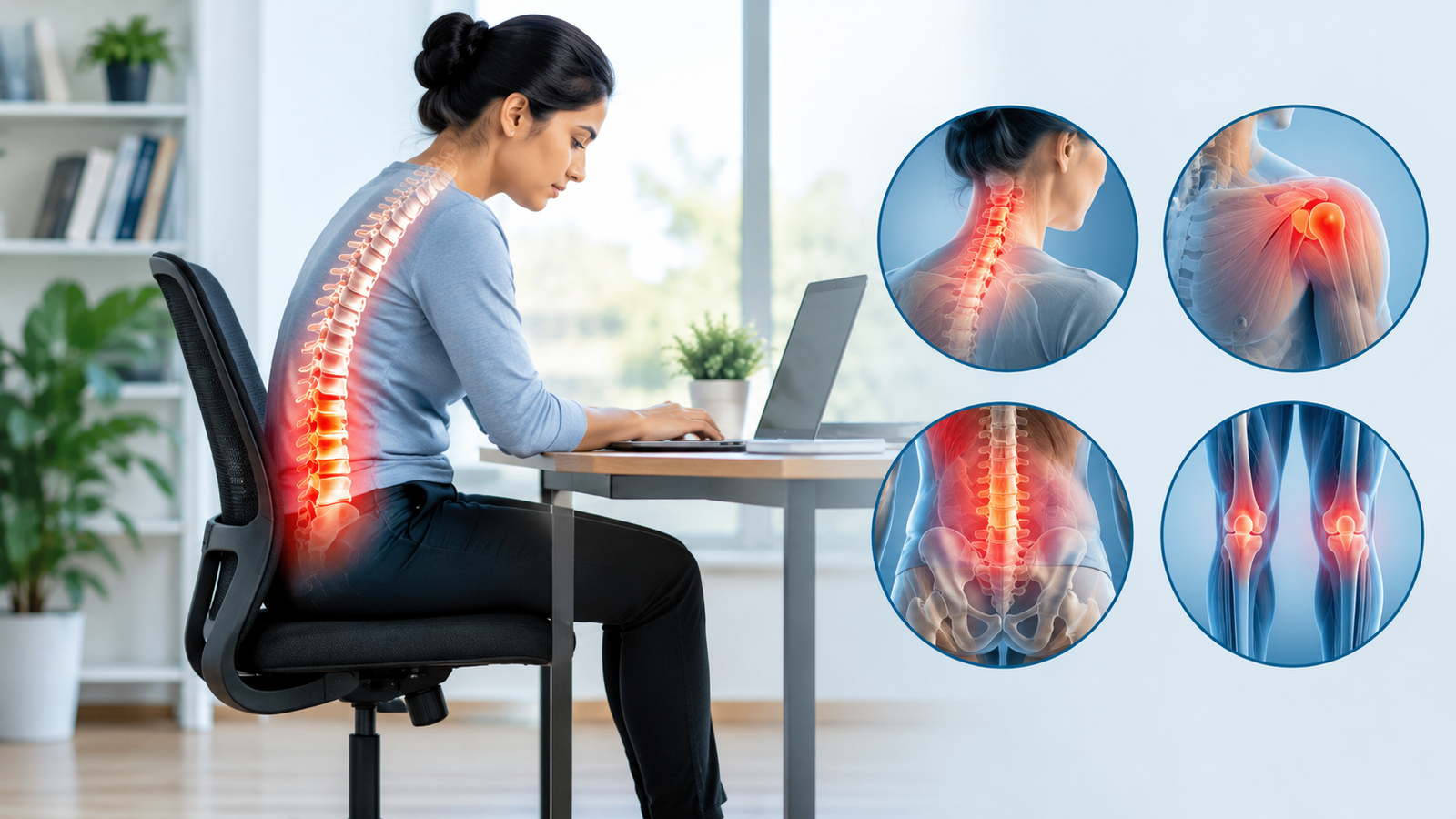
Discover how prolonged sitting can contribute to back pain, neck stiffness, hip discomfort and muscle fatigue. Learn practical sitting tips, movement breaks, simple exercises and how physiotherapy may help. Find physiotherapy and rehabilitation options in Nalbari and Rangia, Assam, including clinic visits and home physiotherapy enquiries.
Have you ever spent hours sitting at your office desk, studying for an examination, driving, or scrolling through your phone, only to notice neck stiffness, lower back pain, or shoulder discomfort later in the day?
You may feel perfectly comfortable while sitting. There may be no immediate pain, no obvious warning sign, and no reason to think that anything is wrong. However, after several hours—or sometimes the following morning—you may experience muscle tightness, restricted movement, back discomfort, or difficulty standing up straight.
This is one reason the phrase “Same Chair, No Pain Today, But Pain Tomorrow” deserves attention.
Prolonged sitting does not automatically damage your spine, and sitting itself is not harmful in every situation. The concern is often the combination of sitting for long periods, limited movement, sustained postures, inadequate physical activity, and individual factors such as previous injuries, muscle capacity, stress, and sleep quality.
For office workers, students, drivers, remote workers, and people who spend much of their day sitting, understanding these factors can help prevent recurring discomfort and support better physical health.
Physiotherapy can play an important role in identifying movement-related problems, improving physical capacity, managing existing pain, and helping people develop sustainable sitting and movement habits.
In this article, we explain how prolonged sitting affects the body, why symptoms may appear hours later, which warning signs should not be ignored, and how physiotherapy and simple home strategies can help.
What Is Prolonged Sitting?
Prolonged sitting refers to spending extended periods in a seated position, particularly when sitting is uninterrupted by standing, walking, or other movement.
There is no single sitting-duration threshold that causes pain in everyone. Your response depends on several factors, including:
- How long you sit without changing position.
- Your usual physical activity level.
- Your workstation or chair setup.
- The demands of your job or daily routine.
- Previous episodes of back, neck, or joint pain.
- Your muscle strength, mobility, recovery, and general health.
For example, a person who sits for six hours with regular movement breaks may feel different from someone who sits for the same amount of time without moving.
The goal is not to eliminate sitting completely. It is to reduce unnecessary uninterrupted sitting and build more movement into your day.
Why You May Feel Fine Today but Experience Pain Tomorrow
Pain does not always appear at the exact moment a physical demand begins. Symptoms can develop gradually or become noticeable after you change position, finish work, or wake up the following morning.
Several factors may contribute.
1. Sustained Postures Can Increase Physical Discomfort
When you remain in one position for a long time, certain muscles and other tissues continue working to maintain that posture.
For example, holding your head forward while looking at a laptop may increase the demand on the muscles around your neck and upper back. Leaning forward over a desk may also change the loading experienced by your back.
Over time, you may notice stiffness, fatigue, or discomfort.
This does not mean your posture is necessarily damaging your body. Rather, a position that feels comfortable initially may become uncomfortable when maintained for too long.
2. Muscles May Become Tired or Less Comfortable
Your muscles do not need to perform heavy exercise to experience fatigue. Maintaining a relatively low-level contraction for a long time can also contribute to discomfort.
During prolonged desk work, muscles around the neck, shoulders, trunk, and hips may remain active for extended periods.
Changing position, walking briefly, and using your muscles in different ways can help reduce the demand associated with one sustained posture.
3. Reduced Movement Can Make Stiffness More Noticeable
Movement allows joints and surrounding tissues to experience different positions and loading patterns.
After sitting for a long time, you may notice stiffness when you stand, straighten your back, or begin walking. This is particularly common among people who already experience recurrent musculoskeletal discomfort.
Stiffness after sitting does not automatically indicate arthritis, a slipped disc, or permanent spinal damage. A proper assessment is needed if symptoms persist, worsen, or interfere with daily activities.
4. Your Total Daily Activity Matters
Sitting is only one part of your daily routine.
Someone who sits for work but walks regularly, performs strengthening exercises, and participates in recreational activities has a different overall movement pattern from someone who sits for most of the day and rarely exercises.
Regular physical activity supports muscle strength, cardiovascular health, joint function, and general well-being.
5. Pain Can Be Influenced by More Than Posture
Pain is a complex experience. It can be affected by physical loading, previous injuries, sleep, stress, fatigue, expectations, and the demands of your daily activities.
For this reason, two people using the same chair may have very different experiences.
If you experience pain after sitting, it does not necessarily mean that you have been sitting incorrectly. The important question is how your symptoms behave, what activities aggravate them, and what changes may help.
How Prolonged Sitting Affects Different Parts of Your Body
1. Lower Back: The Common Problem of Sitting-Related Back Pain
Lower back discomfort is one of the most frequent complaints among people who spend long hours at a desk or behind the wheel.
Sitting changes how forces are distributed through your trunk and hips. Depending on your position, chair support, and movement habits, prolonged sitting may aggravate existing lower back symptoms.
You may notice:
- A dull ache across the lower back.
- Stiffness when standing after sitting.
- Discomfort during long meetings or journeys.
- Difficulty remaining in one position.
- Relief when walking or changing posture.
However, lower back pain has many possible causes. Prolonged sitting may contribute to symptoms, but it is not the only explanation.
What can help?
- Alternate between sitting, standing, and walking.
- Adjust your chair so that your feet are supported.
- Use back support if it makes sitting more comfortable.
- Change your sitting position periodically.
- Include appropriate trunk, hip, and leg strengthening exercises in your routine.
If your pain repeatedly returns or limits your work, a physiotherapist can assess your movement, strength, mobility, and activity tolerance.
2. Neck Pain: The Effect of Looking at Screens for Hours
Neck discomfort often develops when people spend extended periods looking at a laptop, desktop monitor, or mobile phone.
A screen positioned too low or too far away may encourage you to lean forward or hold your head in one position.
Possible symptoms include:
- Neck stiffness.
- Discomfort when turning your head.
- Tightness around the shoulders.
- Headaches associated with neck discomfort.
- Pain that increases after prolonged screen use.
These symptoms can have several causes, so they should not automatically be attributed to posture alone.
Practical steps to reduce neck strain:
- Position your main screen approximately at eye level.
- Keep the screen at a comfortable viewing distance.
- Bring your phone closer to eye level when practical.
- Relax your shoulders rather than holding them raised.
- Take short movement breaks during screen-based work.
If neck pain travels into your arm or is accompanied by tingling, numbness, or weakness, seek professional assessment.
3. Shoulders and Upper Back: Why Desk Work Can Feel Heavy
Desk-based tasks often involve holding the arms in front of the body while using a keyboard, mouse, or mobile device.
If the workstation is poorly arranged, your shoulders may remain elevated or your upper back may stay in a sustained position.
This may contribute to:
- Shoulder fatigue.
- Tightness between the shoulder blades.
- Upper back discomfort.
- Reduced comfort during overhead activities.
- Difficulty maintaining a comfortable working position.
Useful strategies include supporting your forearms when appropriate, positioning the keyboard and mouse within easy reach, and changing your upper-body position regularly.
Shoulder pain may also arise from tendon, joint, or other conditions. Persistent symptoms deserve an individual assessment rather than relying exclusively on posture correction.
4. Hips: Stiffness After Long Hours in a Chair
When you sit, your hips remain flexed. Staying in this position for extended periods may make movement feel stiff or uncomfortable, particularly when you stand up after a long session.
Some people also notice discomfort around the front of the hips or a reduced sense of ease when extending the legs behind the body.
However, sitting does not inevitably cause permanently shortened hip flexor muscles. Muscle flexibility and joint movement are influenced by multiple factors, including activity, training, and individual anatomy.
Helpful options include:
- Standing up periodically.
- Walking for a few minutes.
- Performing gentle hip extension movements if comfortable.
- Strengthening the gluteal muscles and other relevant muscle groups.
- Avoiding exercises that reproduce significant pain.
5. Legs and Circulation: Why Movement Breaks Matter
Remaining seated for long periods reduces the amount of movement performed by your leg muscles.
This may contribute to temporary leg stiffness, discomfort, or swelling in some people. Long periods of immobility can also increase the risk of blood clots in susceptible individuals, especially during prolonged travel or when other risk factors are present.
Simple movements such as walking and ankle pumps can help maintain lower-limb activity.
However, sudden swelling or pain in one leg should not be dismissed as ordinary sitting-related stiffness. A blood clot is one possible cause and requires urgent medical assessment.
6. Overall Health: The Importance of an Active Routine
The effects of prolonged sitting extend beyond muscles and joints.
High amounts of sedentary time are associated with adverse health outcomes, including increased risk of cardiovascular and metabolic conditions. Regular physical activity can help improve overall health and reduce some of the risks associated with inactivity.
This does not mean that sitting for a particular number of hours guarantees illness. Overall activity levels, health conditions, genetics, and other lifestyle factors all matter.
A balanced routine should include regular movement throughout the day and appropriate weekly physical activity, rather than relying only on occasional exercise after many hours of inactivity.
Is Your Chair the Real Problem?
A chair can influence comfort, but there is rarely one perfect chair or one ideal sitting posture for everyone.
An uncomfortable or poorly adjusted chair may make it harder to maintain a comfortable working position. However, even an expensive ergonomic chair cannot replace regular movement, physical activity, and appropriate exercise.
Instead of searching for a chair that promises to prevent every type of pain, focus on making your workspace adjustable and comfortable.
A Simple Ergonomic Checklist for Your Workstation
Chair and feet
- Adjust the chair height so your feet are supported by the floor or a footrest.
- Aim for a comfortable hip and knee position, often around a right angle but not necessarily exactly 90 degrees.
- Use lumbar support if it improves your comfort.
- Avoid pressure from the front edge of the seat behind your knees.
Desk and arms
- Keep your keyboard and mouse close enough to avoid repeatedly reaching forward.
- Let your shoulders remain relaxed.
- Position your elbows comfortably near your sides.
- Adjust armrests, if present, so they do not force your shoulders upward.
Monitor and screen
- Place the main monitor directly in front of you.
- Position the screen so you can read without repeatedly bending your neck.
- Increase text size if you need to lean forward to see clearly.
- If using a laptop for extended periods, consider a separate keyboard and mouse when practical.
Movement
- Stand or walk periodically.
- Change position when discomfort begins to develop.
- Avoid treating any single posture as something you must maintain perfectly all day.
Remember that an ergonomic setup should support comfortable movement, not make you afraid of moving incorrectly.
How Often Should You Take a Break From Sitting?
There is no universally established break interval that prevents all sitting-related pain.
A practical starting point is to interrupt prolonged sitting approximately every 30–60 minutes, or earlier if you become uncomfortable. This is a flexible habit, not a medical rule or guaranteed prevention strategy.
You can try:
- Standing for a short period between tasks.
- Walking while taking a phone call.
- Getting water from another part of the building.
- Performing a few gentle shoulder rolls.
- Moving your ankles and straightening your legs.
- Alternating between seated and standing tasks when possible.
Even short movement breaks can make your working day less sedentary.
If your job does not allow frequent breaks, look for realistic opportunities to move before work, during lunch, between appointments, or after completing a task.
Consistency is generally more useful than following a complicated routine that is difficult to maintain.
Five Simple Exercises for People Who Sit for Long Hours
The following movements may help you introduce more activity into your day. They are general suggestions, not a personalised rehabilitation programme.
Move slowly, breathe normally, and stay within a comfortable range. Stop if an exercise causes sharp pain, increasing radiating symptoms, dizziness, or other concerning symptoms.
1. Gentle Neck Turns
Purpose: To move the neck after prolonged screen use.
How to perform:
- Sit or stand comfortably.
- Keep your shoulders relaxed.
- Slowly turn your head to one side.
- Return to the centre and repeat on the other side.
- Perform approximately 5 repetitions per side, within a comfortable range.
Do not force your head to turn farther than feels comfortable.
2. Shoulder Rolls
Purpose: To encourage movement around the shoulders.
How to perform:
- Sit or stand upright without stiffening your body.
- Gently raise your shoulders.
- Roll them backward and downward.
- Repeat 8–10 times.
- Reverse the direction if comfortable.
Avoid forceful movements if you have an acute shoulder injury.
3. Seated Knee Straightening
Purpose: To move the knees and activate the thigh muscles.
How to perform:
- Sit securely on a stable chair.
- Slowly straighten one knee.
- Hold briefly without forcing the movement.
- Lower the foot with control.
- Repeat 8–10 times on each leg, as tolerated.
If this produces knee pain or aggravates symptoms, reduce the range or stop.
4. Sit-to-Stand
Purpose: To practise a functional movement and activate the muscles of the legs and hips.
How to perform:
- Sit near the front of a stable chair.
- Place your feet securely on the floor.
- Lean forward slightly from the hips.
- Stand up using your legs, with hand support if needed.
- Sit down slowly and with control.
Begin with 5 repetitions if appropriate for your fitness and symptoms.
People with significant balance problems, recent surgery, or difficulty standing safely should seek individual advice before attempting this exercise.
5. Gentle Standing Hip Extension
Purpose: To introduce movement in the hips after prolonged flexion.
How to perform:
- Stand near a sturdy support.
- Keep your trunk comfortably upright.
- Move one leg a short distance backward without arching your lower back.
- Return to the starting position.
- Repeat 5–10 times on each side, if comfortable.
Avoid swinging the leg or forcing the movement.
How to Use These Exercises
You do not need to perform every exercise during every break.
Choose one or two movements that fit your situation, combine them with short walks, and gradually build a routine that feels manageable.
If you have persistent pain, a recent injury, a neurological condition, or a medical restriction on exercise, ask a qualified healthcare professional which movements are appropriate for you.
How Physiotherapy Helps With Sitting-Related Pain
Physiotherapy is not simply massage or a collection of exercises. It involves assessing a person’s symptoms, movement, physical capacity, functional limitations, and goals before selecting appropriate treatment.
For people who develop neck pain, lower back pain, hip stiffness, or shoulder discomfort after prolonged sitting, physiotherapy may help address the factors contributing to their symptoms.
1. Comprehensive Physiotherapy Assessment
A physiotherapist may ask about:
- When the pain began.
- How long you sit each day.
- Which positions or activities aggravate or relieve symptoms.
- Whether pain travels into the arms or legs.
- Your previous injuries and relevant medical history.
- Your sleep, work demands, and physical activity.
- Any associated numbness, weakness, or other warning signs.
The physical examination may include movement assessment, strength testing, functional tasks, and neurological screening when indicated.
Imaging is not automatically required for every episode of back or neck pain. The need for further investigation depends on the clinical findings and relevant warning signs.
2. Individualised Therapeutic Exercise
Exercise is an important part of managing many musculoskeletal conditions.
Depending on the assessment, a physiotherapist may prescribe:
- Trunk and back strengthening.
- Hip and gluteal muscle exercises.
- Neck and shoulder exercises.
- Mobility exercises.
- Balance and functional training.
- A graded programme to increase walking or general activity.
The choice of exercise depends on your symptoms, capacity, medical history, and goals.
3. Ergonomic and Movement Education
A physiotherapist can help you identify practical changes to your workstation and daily routine.
This may include adjusting screen height, improving keyboard placement, using appropriate chair support, planning movement breaks, and modifying tasks that repeatedly aggravate symptoms.
The objective is not to maintain a rigid posture. It is to help you find comfortable working positions and change them regularly.
4. Manual Therapy When Appropriate
Some patients may benefit from hands-on techniques, such as selected soft-tissue techniques or joint mobilisation, as part of a broader treatment programme.
Manual therapy may provide short-term symptom relief in suitable cases, but it is not necessary for everyone and should not replace appropriate activity, education, or exercise.
5. Gradual Return to Work and Daily Activities
If pain has made it difficult to sit, drive, study, or perform household activities, a physiotherapist can help you build tolerance gradually.
Progress may involve adjusting work periods, introducing movement breaks, increasing exercise difficulty, and monitoring how symptoms respond.
Recovery varies from person to person. The goal is to improve function and help you manage your condition safely rather than promise a fixed recovery time.
Home Advice: A Practical Daily Routine for Desk Workers
Small changes can be easier to maintain than a complete lifestyle overhaul.
In the Morning
- Begin with a few minutes of comfortable movement.
- Walk if your schedule and health allow.
- Avoid starting the day with prolonged uninterrupted screen time.
- If you already have pain, choose gentle movements that do not aggravate it.
During Working Hours
- Set a reminder to change position periodically.
- Keep frequently used items within comfortable reach.
- Avoid holding your phone between your ear and shoulder.
- Stand or walk briefly between tasks.
- Use a headset for longer calls if appropriate.
- Alternate sitting and standing if your workstation allows it.
After Work
- Include a walk or another form of physical activity suited to your abilities.
- Perform your prescribed physiotherapy exercises.
- Break up evening screen time with regular movement.
- Avoid using prolonged bed rest as the default response to ordinary back discomfort.
For Students
Students preparing for examinations may sit for long hours without noticing how little they move.
To make studying more comfortable:
- Divide study sessions into manageable blocks.
- Place books and screens at a comfortable viewing height.
- Stand and move between study sessions.
- Use a chair and desk that allow your feet and arms to be supported.
- Maintain a regular sleep routine.
For Drivers and People Who Travel Frequently
Driving combines prolonged sitting with limited opportunities to move.
When safe and practical:
- Adjust your seat before starting the journey.
- Support your back comfortably.
- Keep controls within easy reach.
- Take appropriate breaks during longer journeys.
- Walk briefly when you stop, if safe.
People with a history of blood clots or other significant medical risk factors should ask their healthcare professional about suitable travel precautions.
When Should You Seek Medical Attention?
Most episodes of uncomplicated musculoskeletal discomfort do not require emergency treatment. However, certain symptoms need prompt medical assessment.
Seek Emergency Care for Warning Signs Such as:
- New difficulty controlling your bladder or bowel.
- New numbness around the groin, genitals, or saddle region.
- Significant or rapidly progressing weakness in one or both legs.
- Back pain accompanied by new severe neurological symptoms.
- Chest pain, sudden shortness of breath, or collapse.
These symptoms may indicate a serious condition and should not be managed with home exercises alone.
Seek Urgent Medical Assessment for:
- New swelling, warmth, or pain in one leg, particularly after prolonged immobility.
- Fever with significant back pain or feeling seriously unwell.
- Severe pain following a substantial injury.
- New or progressive numbness or weakness.
- Severe, persistent pain that is worsening or accompanied by other concerning symptoms.
Sudden leg swelling with chest pain or breathlessness is an emergency.
Arrange a Routine Clinical Assessment If:
- Pain repeatedly returns after sitting.
- Neck or back discomfort interferes with work or sleep.
- Symptoms are not improving with reasonable activity modification.
- You have persistent tingling or pain radiating into an arm or leg.
- You increasingly avoid normal activities because of discomfort.
A physiotherapist or other appropriate healthcare professional can help determine the likely cause and whether further medical investigation is needed.
Common Myths About Prolonged Sitting
Myth 1: Sitting Is Always Bad for Your Spine
Fact: Sitting is a normal activity. Problems are more likely to arise from a combination of individual sensitivity, sustained positions, inadequate movement, and other contributing factors. You do not need to avoid sitting completely.
Myth 2: Perfect Posture Prevents All Back Pain
Fact: There is no single posture that guarantees freedom from pain. Comfortable positioning, regular movement, appropriate exercise, and individual assessment are more useful than trying to hold one rigid position all day.
Myth 3: A Good Ergonomic Chair Is Enough
Fact: A supportive chair may improve comfort, but it does not replace physical activity, movement breaks, or a balanced exercise routine.
Myth 4: If Sitting Causes Pain, Your Spine Must Be Damaged
Fact: Pain can occur without serious structural damage. Its cause depends on several factors, and persistent or concerning symptoms deserve proper assessment rather than self-diagnosis.
Myth 5: Resting Completely Is the Best Way to Recover
Fact: For many uncomplicated musculoskeletal conditions, continuing suitable daily activities and gradually increasing movement is preferable to prolonged bed rest. The right approach depends on the diagnosis and individual circumstances.
Physiotherapy & Rehabilitation in Nalbari and Rangia, Assam
Get Professional Help for Sitting-Related Neck and Back Pain
If prolonged sitting is causing recurring lower back pain, neck stiffness, shoulder discomfort, or hip tightness, it may be helpful to seek a professional physiotherapy assessment rather than relying on temporary relief alone.
For people living in Nalbari, Rangia, Dhamdhama, Dimu, and nearby areas of Assam, physiotherapy can help identify contributing factors, assess movement and physical capacity, and develop a suitable management plan.
At your assessment, the physiotherapist may review your daily sitting habits, workstation setup, symptoms, relevant medical history, and movement patterns. Depending on the findings, treatment may include therapeutic exercises, mobility training, ergonomic education, activity modification, and other appropriate rehabilitation techniques.
The aim is to help you manage your symptoms, improve functional movement, and return to your usual activities with greater confidence. Treatment recommendations and progress will depend on your individual condition.
Visit Our Physiotherapy and Rehabilitation Centres
Patients from Nalbari, Rangia, and surrounding communities can visit the following locations to enquire about physiotherapy and rehabilitation services.
1. Dr. Jehu’s KinetiQure Physiotherapy & Rehabilitation Center
Khatikuchi, Nalbari, Assam – 781369
A local option for patients seeking physiotherapy assessment and guidance for musculoskeletal discomfort, including symptoms associated with prolonged sitting.
2. RevitaFlex PhysioCare – Dhamdhama Branch
Dhamdhama–Santipur Road, Near Dhamdhama Bus Stand, Dhamdhama, Nalbari, Assam – 781349
Conveniently located for patients in Dhamdhama and nearby areas who wish to enquire about physiotherapy and rehabilitation support.
3. RevitaFlex PhysioCare – Dimu Branch
Dimu–Dobok Chariali, Dimu–Baharghat Road, Dimu, Rangia, Assam – 781380
An option for patients in Dimu, Rangia, and neighbouring communities seeking assessment and guidance for movement-related pain and functional difficulties.
Home Physiotherapy Visit in Nalbari and Rangia
For people who find it difficult to travel to a clinic, home physiotherapy visits may be an option, subject to availability and clinical suitability.
Dr. Jehirul Islam (PT), Consultant Physio
- Contact/WhatsApp: +91 7086225195
- Email: draaryanphysio@gmail.com
You can enquire about a home physiotherapy assessment for sitting-related back pain, neck discomfort, mobility difficulties, and other rehabilitation needs.
When contacting the physiotherapist, briefly explain your symptoms, how long they have been present, whether they worsen after sitting, and whether you have experienced any numbness, weakness, or other concerning symptoms. This information can help determine the appropriate next step.
Frequently Asked Questions About Prolonged Sitting and Physiotherapy
1. Can prolonged sitting cause lower back pain?
Prolonged sitting may aggravate or contribute to lower back pain, particularly when combined with limited movement, sustained positions, or existing musculoskeletal sensitivity. However, back pain has multiple possible causes, and sitting is not always the primary factor.
2. Why does my back hurt after sitting even when my chair feels comfortable?
A comfortable chair does not eliminate the physical demands of remaining in one position for an extended period. Muscle fatigue, reduced movement, previous injuries, and individual sensitivity may all contribute. Changing positions and taking movement breaks may help.
3. How many hours of sitting are safe per day?
There is no universal number of sitting hours that guarantees safety for every person. Health outcomes depend on total sedentary time, physical activity, individual risk factors, and general health. Reducing prolonged uninterrupted sitting and meeting appropriate physical activity recommendations are sensible goals.
4. How often should I stand up from my chair?
A practical starting point is to stand, walk, or change position approximately every 30–60 minutes, or sooner if you become uncomfortable. This is a flexible habit rather than a strict medical threshold. Adjust the frequency to your needs and working conditions.
5. What is the best sitting posture for preventing back pain?
The best position is one that feels reasonably comfortable and allows you to work without unnecessary strain. Support your feet, position your screen comfortably, and avoid staying in one position for too long. Regularly changing posture is generally more practical than maintaining a supposedly perfect position.
6. Can physiotherapy help with neck and back pain caused by desk work?
Physiotherapy may help through clinical assessment, therapeutic exercise, activity modification, ergonomic advice, and selected hands-on techniques when appropriate. Treatment should be tailored to your symptoms, examination findings, health history, and functional goals.
7. Which exercises are suitable for people who sit all day?
Depending on your abilities and symptoms, options may include gentle neck movements, shoulder rolls, walking, sit-to-stand practice, and appropriate strengthening exercises. People with persistent pain, recent injuries, or relevant medical conditions should seek individual advice before starting a new exercise programme.
8. Can prolonged sitting cause hip stiffness?
Long periods of sitting can make the hips feel stiff when you stand or begin walking. Regular movement and appropriate hip mobility and strengthening exercises may help. Persistent hip pain or significant restriction should be assessed to identify other possible causes.
9. When should I see a physiotherapist for sitting-related pain?
Consider a physiotherapy assessment if back, neck, hip, or shoulder discomfort repeatedly returns, affects your daily activities, or does not improve with reasonable changes to your routine. New neurological symptoms, severe pain, or other warning signs may require urgent medical assessment instead.
10. Where can I get physiotherapy for sitting-related back or neck pain in Nalbari or Rangia, Assam?
Patients in Nalbari, Rangia, and nearby areas can seek an individual physiotherapy assessment to investigate recurring discomfort associated with desk work, prolonged sitting, driving, or other daily activities. Dr. Jehu’s KinetiQure Physiotherapy & Rehabilitation Center in Nalbari and RevitaFlex PhysioCare branches in Dhamdhama and Dimu provide local options for patients to enquire about physiotherapy services. Home physiotherapy visits may also be arranged by contacting Dr. Jehirul Islam (PT) to discuss availability and suitability.
Final Thoughts: Do Not Wait for Tomorrow’s Pain to Change Today’s Habits
The same chair that feels comfortable in the morning may become uncomfortable after hours of uninterrupted sitting. That does not automatically mean your spine is damaged or that you need an expensive chair.
Often, a better starting point is to understand your symptoms, vary your position, move regularly, maintain suitable physical activity, and make practical adjustments to your working environment.
If your discomfort repeatedly returns, interferes with daily activities, or comes with concerning symptoms, professional assessment can help clarify what is happening and guide the next steps.
Physiotherapy can support better movement, improved strength, symptom management, and a more sustainable approach to work and everyday life.
Remember: the goal is not to sit perfectly all day. It is to give your body more opportunities to move, adapt, and recover.
Clinical Disclaimer
This article is intended for general educational purposes only and does not replace an individual medical assessment, diagnosis, or treatment plan. The information provided may not be suitable for every person or medical condition. Exercise recommendations should be adapted to individual symptoms, abilities, and health history. Stop any activity that causes significant or worsening symptoms and seek appropriate medical advice. Seek urgent medical care for serious warning signs, including new bladder or bowel dysfunction, saddle-region numbness, rapidly progressing weakness, chest pain, or sudden shortness of breath. A qualified healthcare professional can help determine the most appropriate course of care.
 Previous Post
 Next Post